
WORKING YOUNG IN INDIA: OPPORTUNITY OR INSECURITY UNDER THE NEW LABOUR CODES?
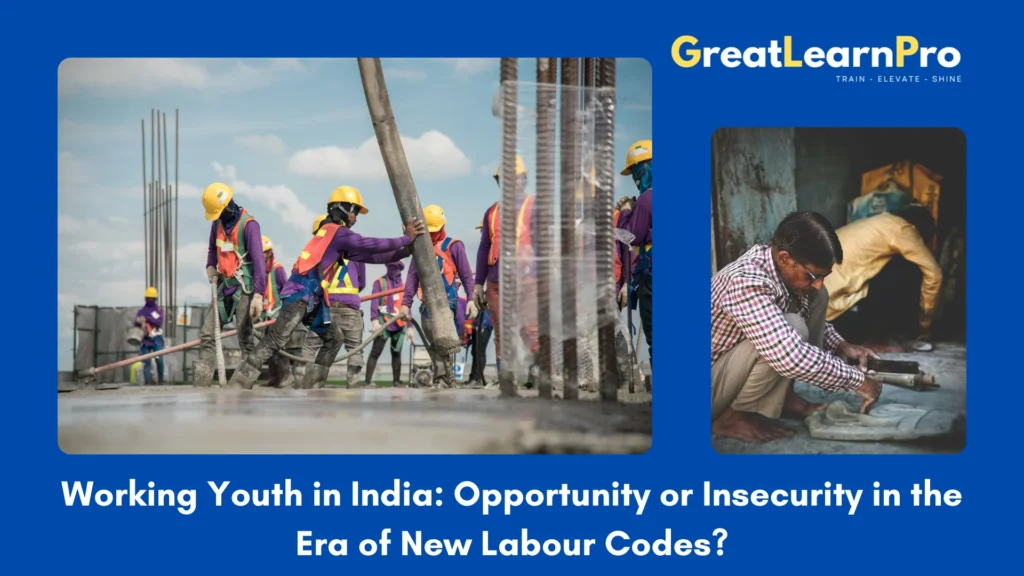
India’s four Labour Codes, brought into force in November 2025, represent the most far-reaching overhaul of labour regulation since Independence. By consolidating 29 central laws into four Codes, the reform aims to simplify compliance, improve ease of doing business, and expand the formalisation of employment. For a country where nearly half the population is under 30, the real test of these Codes lies in how they reshape the future of work for young Indians.
The promise is significant. A statutory national floor wage, clearer rules on contract and fixed-term employment, mandatory appointment letters, and expanded social security coverage signal a move toward a more predictable labour market. Yet the lived reality of youth employment reveals a persistent gap between legal architecture and labour market outcomes—one that risks widening unless addressed with urgency.
Youth Employment and the Persistence of Informality
India’s demographic advantage is often celebrated, but labour market data paints a more complicated picture. Labour force participation among those aged 15–29 remains substantially lower than among older adults, and youth unemployment is consistently higher. Young workers are also far more likely to be trapped in informal employment. Recent survey data shows that close to 90% of young workers remain informally employed, with even regular salaried youth workers facing significant deficits in social security coverage.
Informality among the young is not merely a transitional phase. It is structurally entrenched. Young workers are disproportionately represented as unpaid family workers or in self-employment with low earnings and high precarity. Even within regular salaried employment, contractual insecurity is stark: a majority of young workers lack written contracts, and only a small fraction have long-term contracts exceeding three years. These patterns reflect a labour market that absorbs youth through flexibility rather than stability.
The gender dimension deepens the crisis. Young women face significantly lower participation rates and higher unemployment in urban areas, reflecting the intersection of labour market rigidity, unpaid care burdens, and safety concerns. Without targeted interventions, the new Codes risk reproducing these inequalities rather than correcting them.
What the Labour Codes Change — and What They Do Not
The Labour Codes attempt to correct historical distortions in India’s labour regime. By recognising fixed-term employment and mandating parity in wages and benefits with permanent workers, the Codes respond to the growing prevalence of contract labour among youth. Provisions for guaranteed wage payments, leave entitlements, and clearer definitions of employment categories offer a stronger baseline of protection than earlier fragmented laws.
The Code on Social Security is particularly significant in extending welfare coverage—health, maternity, disability, and education benefits—to unorganised workers and explicitly recognising gig and platform workers. Institutional mechanisms such as national and state social security boards signal intent to adapt labour protection to evolving work arrangements.
Yet large gaps remain. Many provisions for gig and unorganised workers closely mirror earlier frameworks with limited enforcement capacity. Coverage is often tied to enterprise size, excluding workers employed in establishments with fewer than ten employees—where a substantial share of young workers are concentrated. Ambiguities in defining digital platform employment and discretionary rule-making powers further weaken effective inclusion.
More critically, the Codes focus on formalisation without fully confronting the demand side of employment. Labour market flexibility may ease hiring, but without sufficient job creation, skills alignment, and wage growth, youth employment outcomes will remain fragile.
From Legal Reform to Labour Market Reality
The challenge before India is not merely legislative implementation but institutional follow-through. The persistence of contractual insecurity among young workers reflects deeper failures in labour market governance. Weak labour data systems obscure the scale and nature of youth precarity, particularly in gig and platform work where multiple job-holding is common. Without accurate classification and registration, policy interventions risk missing their intended beneficiaries.
The gap between statutory protection and actual access is especially stark in social security. While the Codes expand eligibility in principle, effective coverage depends on proactive registration, employer compliance, and state capacity. Evidence of young workers being denied written contracts, social security benefits, or even timely wages underscores the need for stronger enforcement rather than further dilution.
Most importantly, shifting adolescents and young adults into punitive labour flexibility frameworks without parallel investment in education, skills, mental health, and employment services risks long-term scarring. The future of work cannot be secured by legal simplification alone. It requires a coordinated strategy that treats young workers not as flexible inputs but as human capital whose productivity and security are mutually reinforcing.
India’s demographic moment will not last indefinitely. Whether the Labour Codes translate into opportunity or precarity for the country’s youth will depend on whether formalisation is pursued as a numerical target or as a substantive improvement in work quality. The difference between the two will define the future of work in India.
Tags: Labour Codes, youth employment, future of work, informal labour, gig economy, social security, labour law reform, current affairs
Sources:
- https://epaper.thehindu.com/reader?utm_source=Hindu&utm_medium=Menu&utm_campaign=Header&_gl=1*dlpcf3*_gcl_au*NzU0NzQ1NTA2LjE3Njg3MTYzODkuMjA0Njg0NTMuMTc2OTQ5MjkxNC4xNzY5NDkyOTE0
- https://www.newsonair.gov.in/government-notifies-draft-rules-for-four-labour-codes/
More Current affairs: https://greatlearnpro.com/updates/