
The Persian-Indic Silk Road: Navigating India-Iran Ties
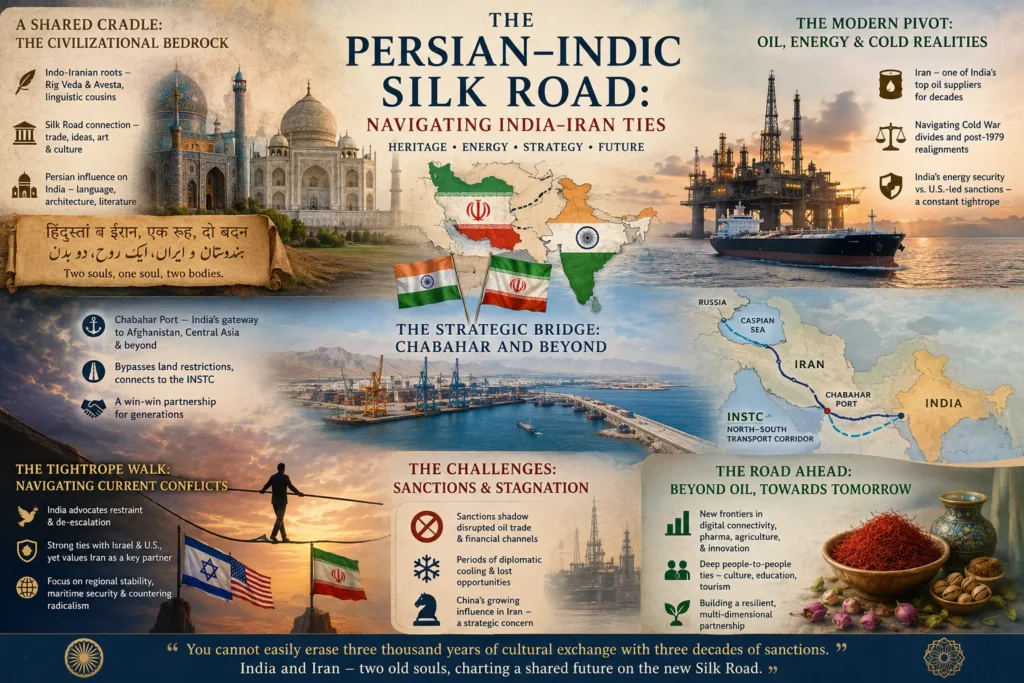
In the grand chessboard of global geopolitics, few relationships are as layered, rhythmic, and occasionally paradoxical as the one between India and Iran. It is a bond that doesn’t just exist in diplomatic dossiers or trade ledgers; it lives in the cadence of Urdu poetry, the blue tiles of medieval monuments, and the shared aroma of saffron and spice.
To understand where these two nations stand today, especially amidst the tremors of modern conflict, we have to look back at a history that predates modern borders by millennia.
A Shared Cradle: The Civilizational Bedrock
Long before the Republic of India or the Islamic Republic of Iran were etched onto maps, the Indo-Iranian people shared a common linguistic and cultural cradle. This wasn’t just proximity; it was an intermingling of DNA. The Rig Veda and the Avesta (the sacred text of Zoroastrianism) are linguistic cousins, mirroring each other in philosophy and structure.
As centuries rolled by, this connection deepened through the Silk Road. Persian became the court language of the Mughal Empire, shaping India’s administration, art, and literature for generations. From the architecture of the Taj Mahal to the very vocabulary of Hindustani, the Persian influence is so deeply embedded in the Indian psyche that it is often invisible. This “civilizational soft power” is the invisible safety net that prevents the relationship from ever hitting rock bottom, even when political interests diverge.
The Modern Pivot: Oil, Energy, and Cold Realities
Fast forward to the 20th century, and the relationship transitioned from poetry to petroleum. Post-1947, India and Iran had to navigate a world divided by the Cold War. While there were periods of misalignment, Iran was a key U.S. ally during the Shah’s era while India leaned toward the Soviet Union, the 1979 Revolution changed the calculus.
For a modern, energy-hungry India, Iran became a vital pillar of energy security. Iran sits on some of the world’s largest oil and gas reserves, and for decades, it was one of India’s top three oil suppliers. This wasn’t just a buyer-seller dynamic; it was a strategic dependency. However, this energy link has always been the “Achilles’ heel” of the relationship, as India often found itself squeezed between its need for Iranian oil and the tightening grip of U.S.-led international sanctions.
The Strategic Bridge: Chabahar and Beyond
Perhaps the most significant modern chapter is the Chabahar Port. For India, Chabahar is more than just a maritime project; it is a gateway to the world. Locked out of direct land access to Afghanistan and Central Asia due to the geography of Pakistan, India looked to the Iranian coast.
By developing Chabahar, India created a “golden corridor” that bypasses overland restrictions. It’s a win-win: Iran gets infrastructure and investment, and India gets a strategic foothold in the Eurasian heartland. This project remains the crown jewel of their bilateral cooperation, surviving multiple rounds of geopolitical tension because both sides recognize its generational importance.
The Tightrope Walk: Navigating Current Conflicts
As we look at the current global landscape, marked by volatility in the Middle East and shifting alliances, India’s position is a masterclass in “strategic autonomy.”
India finds itself in a delicate balancing act. On one hand, it has a burgeoning, high-tech, and defense-heavy relationship with Israel and a “Comprehensive Strategic Partnership” with the United States. On the other, it cannot afford to lose Iran, which remains a key gateway to the North-South Transport Corridor (INSTC).
When tensions flare in the region, India’s rhetoric is typically one of “restraint” and “de-escalation.” Unlike many Western powers, India rarely views Iran through a purely ideological lens. Instead, Delhi sees Tehran as a necessary partner for regional stability, maritime security in the Indian Ocean, and a counterweight to radicalism in the neighborhood.
The Challenges: Sanctions and Stagnation
It hasn’t all been smooth sailing. The “Sanctions Shadow” has frequently halted progress. When the U.S. pulled out of the nuclear deal (JCPOA) in 2018, India was eventually forced to zero out its oil imports from Iran to avoid secondary sanctions. This led to a period of “diplomatic cooling,” where Tehran felt let down by a friend, and Delhi felt hamstrung by global financial systems.
Furthermore, the rise of Chinese influence in Iran, exemplified by the 25-year strategic pact between Beijing and Tehran, presents a new challenge for Indian planners. India must ensure that its slow-moving bureaucratic processes don’t allow China to become the sole benefactor of Iran’s economic isolation.
Conclusion: A Relationship of Necessity and Heritage
The India-Iran story is a reminder that in international relations, history matters. You cannot easily erase three thousand years of cultural exchange with three decades of sanctions.
As we move deeper into the 21st century, the relationship will likely move beyond just “oil for goods.” We are seeing potential in digital connectivity, pharmaceuticals, and agricultural trade. While the drums of war and the pressures of global power politics will continue to test this bond, the foundation remains solid.
India and Iran are two old souls who have seen empires rise and fall. They understand that while the “current scenario” might be turbulent, the long-term arc of their relationship is defined by a simple truth: they need each other. Whether it’s for a stable Afghanistan, a connected Eurasia, or a balanced Middle East, the Delhi-Tehran axis remains a vital, if quiet, heartbeat of Asian geopolitics.
Sources:
- Wikipedia https://en.wikipedia.org/wiki/India_in_the_2026_Iran_war
- Ministry of External Affairs https://www.mea.gov.in/iran-travel-advisory.htm
- University of Kashmir https://ccas.uok.edu.in/Files/93269b6c-7f53-4439-ae9a-3bdf55a4c649/Journal/b6413404-1f78-41e7-9116-a458546dcc5d.pdf
- Embassy of India in Tehran https://ccas.uok.edu.in/Files/93269b6c-7f53-4439-ae9a-3bdf55a4c649/Journal/b6413404-1f78-41e7-9116-a458546dcc5d.pdf
More Current Affairs: https://greatlearnpro.com/updates/