
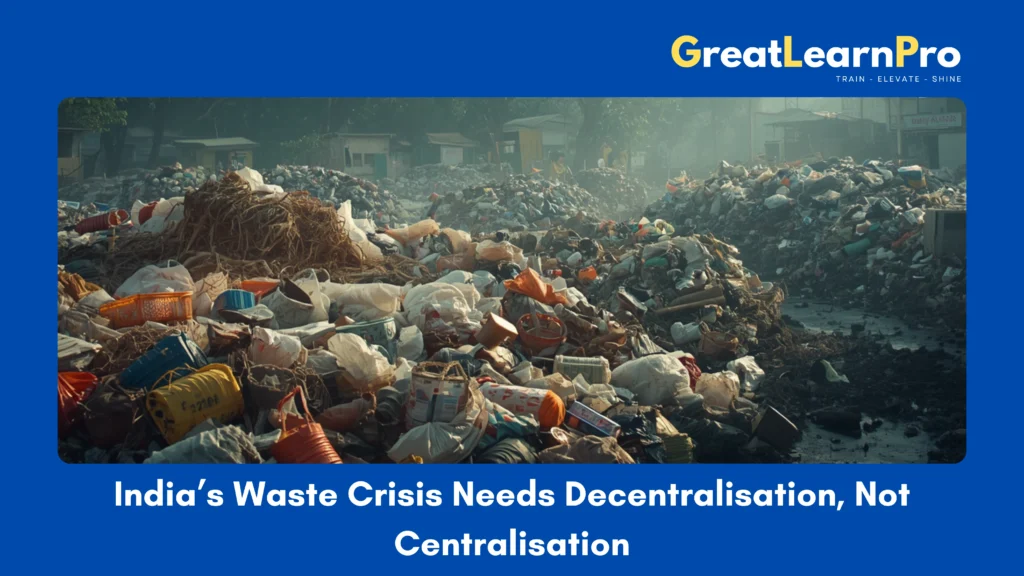
India’s waste crisis is no longer just an urban inconvenience. It has become a national environmental emergency affecting cities, villages, rivers, air quality, public health, and governance itself. Overflowing landfills, plastic-filled drains, toxic lakes, open waste burning, and untreated garbage have become common sights across the country.
Against this backdrop, the Solid Waste Management Rules, 2026 were introduced as an ambitious attempt to modernise India’s waste governance system. The Rules seek to improve waste segregation, reduce landfill dependence, increase recycling, promote scientific processing, and create digital monitoring systems.
At first glance, the reforms appear necessary and progressive.
However, beneath the environmental objectives lies a deeper constitutional and administrative debate: can a country as large and diverse as India solve its waste crisis through a highly centralised framework designed from New Delhi?
Critics argue that the 2026 Rules reflect a technocratic and centralised model of governance that overlooks federalism, local realities, and institutional capacity. Instead of empowering States and local governments, the Rules risk creating excessive compliance systems, bureaucratic reporting, and blurred accountability.
The larger question is not whether India needs stronger waste management reforms — it clearly does. The real question is whether environmental governance can succeed without decentralisation.
India’s Growing Waste Emergency
India generates millions of tonnes of solid waste every year, and the volume continues to rise rapidly due to:
- Urbanisation
- Population growth
- Rising consumption
- Plastic dependency
- E-commerce packaging
- Electronic waste
- Changing rural consumption patterns
The consequences are visible everywhere.
Urban Crisis
Cities are struggling with:
- Overflowing landfills
- Toxic groundwater contamination
- Methane emissions
- Waste fires
- Plastic-choked drainage systems
- Air pollution caused by open burning
Large landfills in cities like Delhi, Mumbai, and Bengaluru have effectively become garbage mountains.
Rural Waste Problem
The waste crisis is no longer limited to urban India.
Rural regions now face:
- Plastic litter
- Sanitary waste
- Pesticide containers
- E-waste
- Non-biodegradable packaging waste
Traditional rural waste systems were designed for biodegradable materials, not modern plastic-heavy consumption.
India clearly required a stronger waste management framework. The problem lies in how the new Rules attempt to implement it.
The Solid Waste Management Rules, 2026
The Solid Waste Management Rules, 2026 replaced the earlier 2016 Rules and came into force on April 1, 2026.
The Rules aim to:
- Improve source segregation
- Promote recycling and composting
- Reduce landfill dependency
- Regulate bulk waste generators
- Introduce digital reporting systems
- Encourage circular economy practices
- Remediate legacy dumpsites
These are important goals.
But environmental intent alone does not guarantee effective governance.
The criticism is not against environmental reform itself. It is against the administrative structure through which the reform is being imposed.
Federalism and Environmental Governance
The Rules are framed under the Environment (Protection) Act, 1986, which derives authority from Article 253 of the Indian Constitution.
Article 253 of the Constitution of India allows Parliament to legislate on matters connected to international agreements and treaties, even if those subjects normally fall within State jurisdiction.
This power emerged largely from India’s commitment to international environmental obligations after the 1972 Stockholm Declaration.
Legally, the Centre possesses wide authority.
But constitutional power and administrative wisdom are not always the same thing.
The central criticism is that national environmental standards should act as a minimum framework — not as a rigid operational blueprint for every village, municipality, and State in India.
The Principle of Subsidiarity
One of the most important governance principles discussed in this debate is subsidiarity.
Subsidiarity means:
Decisions should be taken at the lowest level capable of effectively handling them.
Local problems require local solutions.
Waste management is deeply local because it depends on:
- Local geography
- Population density
- Citizen behaviour
- Infrastructure
- Climate conditions
- Available land
- Informal waste workers
- Financial resources
A model designed for a metropolitan city cannot automatically work in a tribal village, coastal panchayat, hill town, or island settlement.
Yet the 2026 Rules attempt to create a uniform system across vastly different regions.
The “Knowledge Problem” in Centralised Governance
Economist Friedrich Hayek described what he called the “knowledge problem.”
According to Hayek, effective governance depends on local and contextual knowledge — information that cannot be perfectly transmitted to distant central authorities.
Waste management is a perfect example.
Officials in New Delhi cannot fully understand:
- The waste patterns of a Himalayan pilgrimage town
- The logistical challenges of rural panchayats
- The flooding risks of coastal settlements
- The land shortages in dense metropolitan regions
Centralised governance often assumes that uniform rules create efficiency. In reality, they can create rigidity and disconnect policy from ground realities.
The Problem with Over-Centralisation
Critics argue that the new Rules reflect India’s long-standing “centralisation reflex” — the belief that stronger control from the Centre can compensate for administrative weakness at lower levels.
This creates several problems:
1. States Become Implementing Agencies
Instead of designing solutions, States merely execute centrally-designed frameworks.
2. Innovation Declines
Local governments stop experimenting because compliance becomes more important than problem-solving.
3. Accountability Gets Blurred
When policies fail, responsibility shifts between:
- The Centre
- States
- Municipalities
- Pollution control boards
4. Reporting Replaces Governance
Officials spend more time uploading data than improving waste collection systems.
Why Waste Management Must Be Localised
Waste management is one of the most decentralised functions in governance.
It involves:
- Door-to-door collection
- Citizen participation
- Ward-level monitoring
- Local composting
- Informal waste workers
- Land allocation
- Recycling networks
- Community trust
Each region requires a different model.
Metropolitan Cities
Cities like:
- Delhi
- Mumbai
- Chennai
- Bengaluru
need:
- Large-scale processing systems
- Metropolitan waste authorities
- Scientific landfill remediation
- Advanced recycling infrastructure
Rural India
Rural areas need simpler systems focused on:
- Household composting
- Community awareness
- Periodic dry waste collection
- Cluster-based recycling models
- Gram sabha participation
Treating gram panchayats like mini-municipal corporations ignores administrative reality.
Many panchayats lack:
- Sanitation staff
- Collection vehicles
- Engineers
- Digital infrastructure
- Financial resources
Without institutional support, compliance becomes impossible.
States as Laboratories of Innovation
One of the strongest arguments for decentralisation comes from the idea that States should act as policy laboratories.
Different States could experiment with:
- Decentralised composting
- Waste worker cooperatives
- Tourism waste management systems
- Cluster recycling facilities
- Urban waste authorities
- Local user fee models
Successful models could later be adopted nationally.
This approach encourages:
- Innovation
- Competition
- Adaptation
- Faster learning
Centralised systems often discourage experimentation because all regions are forced into the same framework.
Digital Governance vs Ground Reality
The 2026 Rules rely heavily on digital monitoring and centralised reporting systems.
Municipalities and panchayats are expected to:
- Upload waste data
- Maintain dashboards
- Submit reports
- Conduct audits
While digital governance sounds efficient, it creates risks.
Officials may prioritise:
- Data compliance
- Report generation
- Portal uploads
instead of:
- Street cleaning
- Segregation enforcement
- Community engagement
This creates “paper compliance” without actual environmental improvement.
The Financial Problem
One of the biggest weaknesses of India’s local governance system is financial dependency.
The Rules impose major responsibilities on municipalities and panchayats without guaranteeing:
- Stable funding
- Formula-based grants
- Infrastructure support
- Technical assistance
Underfunded mandates often lead to:
- Selective compliance
- Inflated reporting
- Administrative shortcuts
- Weak enforcement
Without predictable finances, even well-designed waste systems struggle to survive.
Citizen Participation Matters
Waste management cannot succeed through bureaucracy alone.
It requires active public participation:
- Segregating waste at source
- Reducing plastic use
- Composting
- Following collection schedules
- Monitoring local authorities
Rural India at least possesses gram sabhas as participatory institutions.
Urban India lacks strong ward-level democratic participation mechanisms.
True decentralisation requires:
- Citizen oversight
- Ward committees
- Public reporting
- Local accountability systems
The Risk of Judicialised Governance
India often responds to administrative failure through litigation.
Critics warn that if the Rules remain unrealistic and underfunded:
- States may fail implementation
- PILs may be filed
- Courts may intervene
- Governance may become judicially monitored
This could create:
- Endless affidavits
- Compliance hearings
- Court-directed administration
Environmental governance would then shift from democratic administration to courtroom management.
What a Better Waste Governance Model Looks Like
A more effective waste management framework would rest on five principles:
1. Minimum National Standards
The Centre should define baseline environmental goals.
2. State Flexibility
States should design systems suited to local realities.
3. Empowered Local Bodies
Municipalities and panchayats need real authority and resources.
4. Predictable Finance
Waste management requires stable and long-term funding.
5. Citizen Accountability
Communities must participate directly in monitoring and implementation.
Conclusion
India’s waste crisis is real, urgent, and dangerous. Strong reforms are necessary to prevent environmental collapse in both urban and rural regions.
But environmental governance cannot succeed through centralisation alone.
The Solid Waste Management Rules, 2026 represent an ambitious attempt to modernise India’s waste systems, yet they also reveal a deeper governance problem: the tendency to impose uniform national solutions on highly diverse local realities.
Waste management succeeds not through distant control, but through local participation, experimentation, accountability, and institutional flexibility.
Cleaner cities and villages will not emerge from dashboards, portals, and central reporting systems alone.
They will emerge when States, municipalities, gram panchayats, waste workers, and citizens are empowered to create solutions that actually fit their own realities.
Without decentralisation, India risks producing more paperwork than progress — while mountains of waste continue to grow across the country.
Source: https://www.thehindu.com/
More Current Affairs: https://greatlearnpro.com/updates/