
Important UG Law Entrance Exams in India 2027- Eligibility, Application Dates and Exam Schedule

Choosing the right law entrance examination is the first major step towards building a successful legal career.
For students completing Class 12, India offers several national, university-level and state-level entrance examinations for admission to five-year integrated law programmes such as B.A. LL.B., B.B.A. LL.B. and B.Com. LL.B.
This guide by GreatLearnPro covers the most important UG law entrance exams for the 2027–28 academic session, along with their eligibility criteria, application timelines and expected examination dates.
Important: Dates for some examinations are tentative and may change. Students should check the official examination website before submitting an application.
Why take a UG law entrance exam?
A five-year integrated law programme allows students to complete an undergraduate degree and an LL.B. in a single course after Class 12. Admission to leading law universities and private institutions is generally based on an entrance test.
A good entrance examination can provide access to:
- National Law Universities and other reputed law schools.
- Strong academic and internship opportunities.
- National and international mooting competitions.
- Better placement and career networks.
- Specialisations in corporate law, litigation, constitutional law, technology law and other fields.
Students from the Arts, Commerce and Science streams can generally apply for integrated law courses, provided they meet the required Class 12 marks.
Major UG law entrance exams
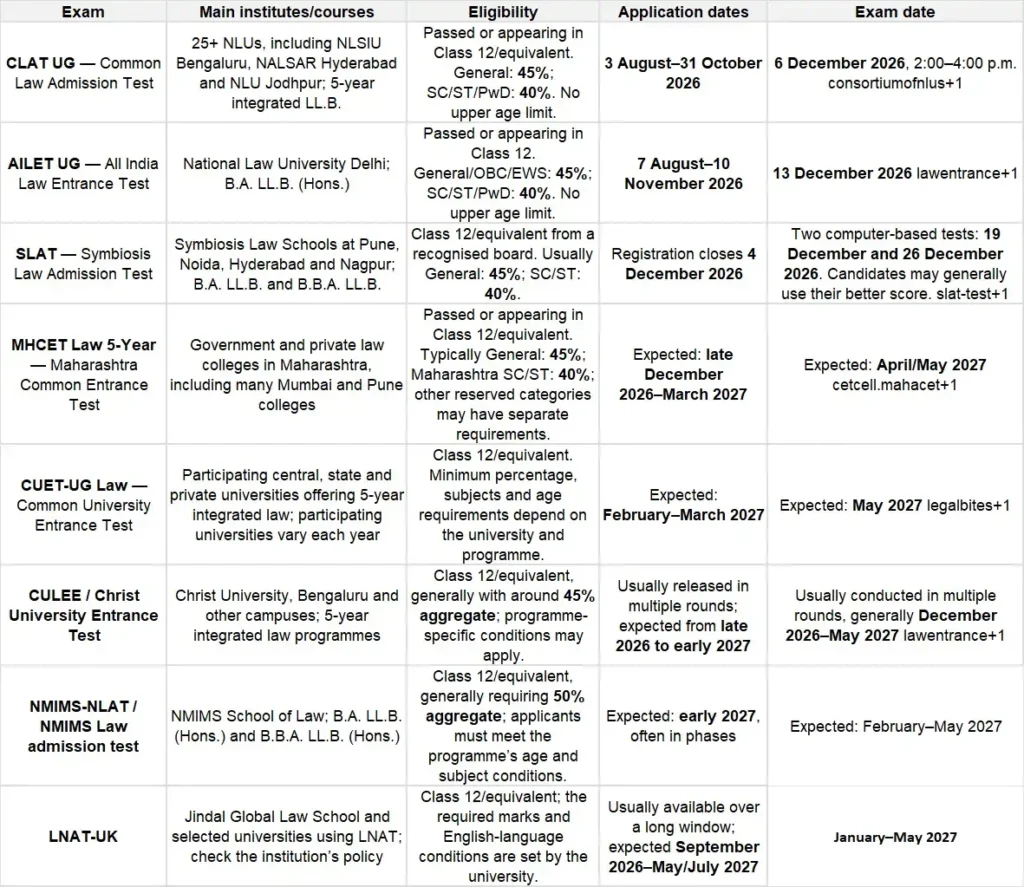
1. CLAT UG
The Common Law Admission Test, commonly known as CLAT, is the most widely recognised entrance examination for five-year integrated law programmes in India. It is conducted by the Consortium of National Law Universities.
A CLAT score is used for admission to participating NLUs and may also be accepted by certain other universities and institutions.
Eligibility
- The candidate must have passed Class 12 or an equivalent examination.
- General, OBC, PwD, NRI, PIO and OCI candidates generally require at least 45%.
- SC/ST candidates generally require at least 40%.
- Students appearing for their Class 12 board examination may apply provisionally.
- There is no upper age limit.
Important dates
- Application period: 3 August to 31 October 2026.
- Examination date: 6 December 2026.
- Mode: Offline, pen-and-paper examination.
CLAT should be the first priority for students targeting leading NLUs, including NLSIU Bengaluru.
2. AILET UG
The All India Law Entrance Test is conducted by National Law University Delhi for admission to its B.A. LL.B. (Hons.) programme. NLU Delhi has its own admission examination and does not use CLAT for its undergraduate law programme.
Eligibility
- The candidate must have passed Class 12 or an equivalent examination.
- General candidates generally need 45%.
- SC/ST/PwD candidates generally need 40%.
- Students appearing for their Class 12 examination may apply.
- There is no upper age limit.
Important dates
- Registration: 7 August to 10 November 2026.
- Examination date: 13 December 2026.
Students who want to study at NLU Delhi should apply for both CLAT and AILET, since the two examinations have separate application processes.
3. SLAT
The Symbiosis Law Admission Test is conducted for admission to the undergraduate law programmes offered by Symbiosis Law Schools.
The test is particularly relevant for students considering law campuses in Pune, Noida, Hyderabad and Nagpur.
Eligibility
- The candidate must have passed Class 12 or an equivalent examination from a recognised board.
- General candidates generally require at least 45%.
- SC/ST candidates generally require at least 40%.
- Students awaiting their Class 12 results may apply, subject to the admission rules.
Important dates
- Registration closes: 4 December 2026.
- SLAT Test 1: 19 December 2026.
- SLAT Test 2: 26 December 2026.
Applicants may usually take one or both tests, subject to the rules of the relevant admission cycle. The better score may be considered for selection.
4. MHCET Law 5-Year
The Maharashtra Common Entrance Test for the five-year LL.B. course is a state-level examination for admission to participating law colleges in Maharashtra.
It can be a useful option for students interested in colleges in Mumbai, Pune and other Maharashtra cities.
Eligibility
- The candidate must have passed or be appearing for Class 12 or an equivalent examination.
- General candidates generally require 45%.
- The minimum marks for reserved categories depend on the applicable Maharashtra rules.
- Candidates should carefully check the domicile and reservation requirements.
Important dates
The 2027 application and examination schedule had not been finally confirmed at the time of writing.
- Expected application period: December 2026 to March 2027.
- Expected examination period: April or May 2027.
5. CUET-UG Law
The Common University Entrance Test—Undergraduate is conducted by the National Testing Agency for participating universities. Some universities use CUET-UG scores for admission to integrated law programmes.
Because participation differs from one institution to another, students should check the admission brochure of every university they are considering.
Eligibility
- The candidate must have passed or be appearing for Class 12 or an equivalent examination.
- The minimum percentage, subject combination and age rules depend on the university.
- Not every university offers law admission through CUET-UG.
Important dates
- Expected application period: February to March 2027.
- Expected examination period: May 2027.
CUET-UG Law is most useful for students who want to keep several participating universities as alternatives.
6. CULEE and Christ University admissions
Christ University offers integrated law programmes through its admission process, commonly associated with the Christ University Entrance Test, or CULEE.
The university may conduct more than one application and selection round during the admission cycle.
Eligibility
- The candidate should have passed or be appearing for Class 12.
- The minimum percentage is generally around 45%, although the exact requirement may vary.
- Students must also satisfy the programme-specific admission conditions.
Important dates
- Applications are generally released in multiple rounds.
- The expected schedule may extend from December 2026 to May 2027.
- Students should check the official Christ University admissions portal for the exact round deadlines.
For students based in Bengaluru, Christ University is an important option because of its location, established academic environment and integrated law programmes.
7. NMIMS-NLAT or NMIMS Law admission test
NMIMS School of Law offers integrated B.A. LL.B. (Hons.) and B.B.A. LL.B. (Hons.) programmes. Its admission process may use an NMIMS-specific law aptitude test or the institution’s notified entrance route.
Eligibility
- The candidate should have passed Class 12 or an equivalent examination.
- The general minimum requirement is usually around 50%.
- Candidates must satisfy the age, subject and other conditions mentioned in the current admission notification.
Important dates
- Applications are expected to open in early 2027.
- The examination may be conducted in multiple phases between February and May 2027.
Applicants should rely on the current NMIMS admission notification because the name and structure of the admission test can change.
8. LNAT-UK
The Law National Aptitude Test, or LNAT, is used by selected universities and law schools. In India, students should verify whether their target institution accepts LNAT scores for the relevant admission year.
The examination focuses mainly on reading comprehension and critical reasoning rather than testing detailed knowledge of law.
Eligibility and dates
- Class 12 or equivalent qualification is normally required by the target university.
- Minimum marks and English-language requirements vary.
- The test is usually available over an extended booking and testing window.
- Application and test deadlines must be checked separately for each participating university.
Application checklist
Before applying for any UG law entrance exam, students should keep the following ready:
- Class 10 and Class 12 details.
- Recent passport-size photograph.
- Scanned signature.
- Government identity document.
- Category, PwD or domicile certificate, where applicable.
- Valid email address and mobile number.
- Online payment method.
- Details of the preferred test centre.
Students should enter their name, date of birth and academic details exactly as they appear in official documents. Mistakes in the application form can create problems during counselling or admission.
How to choose the right exams
Students do not need to limit themselves to one examination. A balanced application strategy could include:
- National-level choices: CLAT and AILET.
- Private university choices: SLAT, CULEE and NMIMS.
- State-level choice: MHCET Law.
- University-specific alternatives: CUET-UG Law and LNAT-UK, wherever accepted.
A student targeting colleges in Bengaluru might consider CLAT, AILET, SLAT, CULEE and NMIMS-related options. This combination provides access to national universities, private institutions and a strong local option.
Final word
The best preparation strategy is to begin with the common areas tested across most exams: English language, logical reasoning, legal reasoning, current affairs and quantitative techniques. Students should create a calendar containing application deadlines, mock-test dates, document requirements and examination dates.
For the 2027–28 cycle, CLAT and AILET applications are already important deadlines, while SLAT registrations and test dates have also been announced. Candidates should monitor official portals regularly because application windows, eligibility rules and examination schedules may be revised. GreatLearnPro can help students organise their preparation with structured study plans, mock tests, current-affairs practice and application guidance.
CLAT Official Website: https://consortiumofnlus.ac.in/clat-2027/