
Vizag’s Data Centre Dream Faces a Reality Check
India may be preparing to host one of Google’s largest AI facilities outside the United States. But before Visakhapatnam can become a global hyperscale hub, it must confront some uncomfortable questions about infrastructure, sustainability, and digital sovereignty.
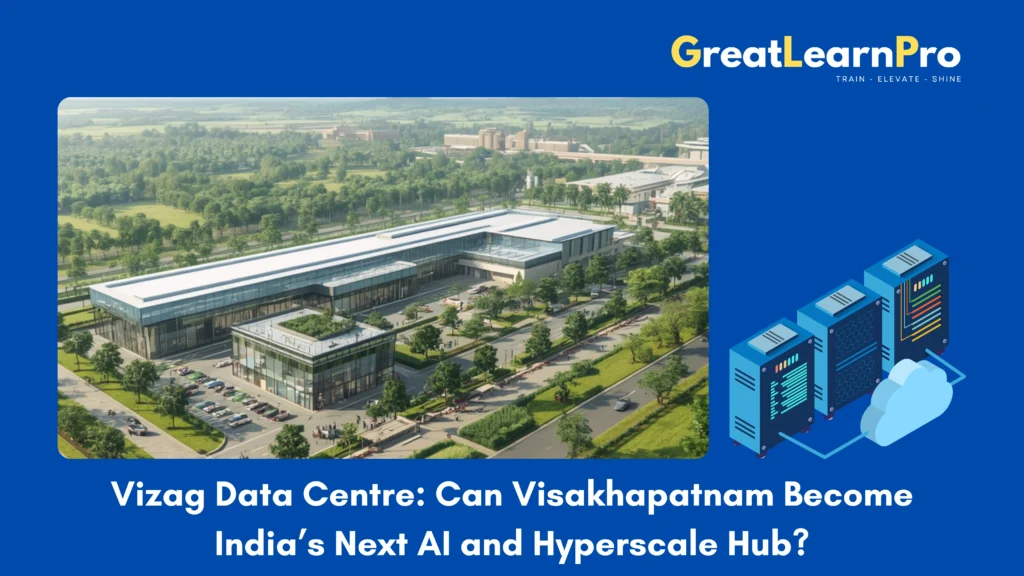
When Google and the Andhra Pradesh government recently broke ground for the Google Cloud India AI Hub in Visakhapatnam, the announcement was widely celebrated as a milestone in India’s digital journey. The symbolism is hard to miss. For decades, India built its reputation as the world’s software back office, supplying talent and services to technology companies across the globe. Now, it is attempting something more ambitious: becoming home to the physical infrastructure that powers the digital economy.
The proposed AI Hub is expected to be part of a broader digital infrastructure ecosystem worth nearly ₹1.25 lakh crore. Combined with new subsea cable projects and large-scale investments in cloud computing, artificial intelligence, and connectivity, Visakhapatnam is being positioned as India’s next major technology gateway.
There is genuine reason for optimism. Yet beneath the excitement lies a difficult question: Is India truly ready for a hyperscale data centre of this magnitude?
The project’s strategic importance is undeniable. Through the America-India Connect initiative, multiple international subsea cables are expected to land in Visakhapatnam, transforming the city into a major digital gateway on India’s eastern coast. This could fundamentally alter how Indian data moves around the world.
At present, much of India’s international internet traffic depends on routes through Mumbai, Chennai, and Kochi. The new infrastructure promises alternative pathways connecting India directly to South Africa, Australia, Singapore, and eventually the United States. In an era marked by geopolitical uncertainty and disruptions to critical maritime routes, reducing dependence on existing cable corridors is a significant advantage.
The benefits do not stop there. A large-scale AI hub could also stimulate demand for advanced computing hardware, networking equipment, and semiconductor components. As India seeks to develop domestic chip manufacturing under its Production Linked Incentive (PLI) schemes, projects like this create a stronger business case for building a local technology ecosystem.
Equally important is the possibility of decentralising India’s technology economy. For years, cities such as Bengaluru, Hyderabad, Mumbai, and Delhi have attracted a disproportionate share of high-value digital investments. A successful hyperscale hub in Visakhapatnam could demonstrate that major technology infrastructure can flourish beyond traditional metropolitan centres.
However, the story becomes more complicated when one looks beyond investment figures and infrastructure announcements.
The proposed facility is expected to require around one gigawatt of power. To put that in perspective, that is comparable to the electricity consumption of a medium-sized city. Artificial intelligence workloads, particularly those involving advanced graphics processing units (GPUs), are among the most energy-intensive forms of computing ever deployed at scale.
This raises concerns about the local power ecosystem. Although Google has committed to sourcing renewable energy for its operations, data centres cannot rely exclusively on intermittent power sources. Backup diesel generators remain a standard feature of hyperscale facilities worldwide. Their use may be infrequent, but their environmental impact cannot be ignored, particularly when facilities operate at such enormous scale.
Yet electricity may not be the project’s greatest challenge.
Water is.
Modern data centres generate immense amounts of heat. Keeping thousands of servers cool requires sophisticated cooling systems, many of which consume large quantities of water. If Google aims to maintain the efficiency levels it has achieved elsewhere, Visakhapatnam’s humid coastal climate could necessitate water-intensive cooling solutions.
Industry estimates suggest that a 100-megawatt facility can consume more than two million litres of water each day. At one gigawatt, water demand could theoretically exceed 20 million litres daily.
This figure becomes particularly troubling when viewed against Visakhapatnam’s existing water realities. The district periodically experiences water stress and relies heavily on inter-basin transfers to meet growing demand. Groundwater availability is already under pressure, and climate variability is expected to intensify resource constraints in the years ahead.
In such a context, the question is no longer whether the city can host a hyperscale data centre. The question is whether it can do so sustainably.
Environmental governance presents another area of concern. Rights groups have argued that the project may have benefited from regulatory classifications that reduced the level of environmental scrutiny required during approval. Whether these allegations are justified or not, the broader issue deserves attention.
Around the world, communities have increasingly demanded greater transparency from large data centre operators regarding energy use, water consumption, emissions, and local environmental impacts. In many cases, public consultations and environmental assessments have led companies to redesign projects, improve resource efficiency, and strengthen community engagement.
India’s regulatory framework for hyperscale infrastructure is still evolving. While states compete aggressively to attract investment through tax incentives and subsidies, environmental safeguards often receive less attention. Without clear national standards governing resource use and sustainability, there is a risk that economic ambitions could outpace responsible planning.
The project also raises a strategic question that receives far less public discussion.
Will India become a global AI hub, or simply a host for foreign-owned AI infrastructure?
The distinction matters. The arrival of Google Cloud undoubtedly strengthens India’s digital capabilities and lowers costs for domestic businesses. However, it also deepens dependence on a proprietary technology ecosystem controlled by a global corporation. Hosting data within national borders is only one aspect of digital sovereignty. Ownership, governance, technological autonomy, and competitive diversity are equally important.
For India to realise its ambition of becoming a leader in artificial intelligence, it must ensure that infrastructure development is accompanied by policies that encourage domestic innovation and reduce long-term dependence on a handful of global providers.
The Google Cloud India AI Hub represents a remarkable opportunity. It signals confidence in India’s digital future and reinforces the country’s growing importance in the global technology landscape. But it also serves as a reminder that the AI revolution is no longer merely a software story.
It is a story about power grids, water resources, environmental accountability, and strategic autonomy.
Visakhapatnam may well become India’s next great technology city. Whether it becomes a model for sustainable digital growth or an example of infrastructure expansion without adequate safeguards will depend on the decisions made long before the first AI model is trained inside its servers.
India’s climb up the digital value chain is necessary and inevitable. The challenge is ensuring that the foundations supporting that climb are as strong as the ambitions driving it.
More Current Affairs: https://greatlearnpro.com/updates/