
Land Pooling Schemes: The Future of Indian Urban Infrastructure
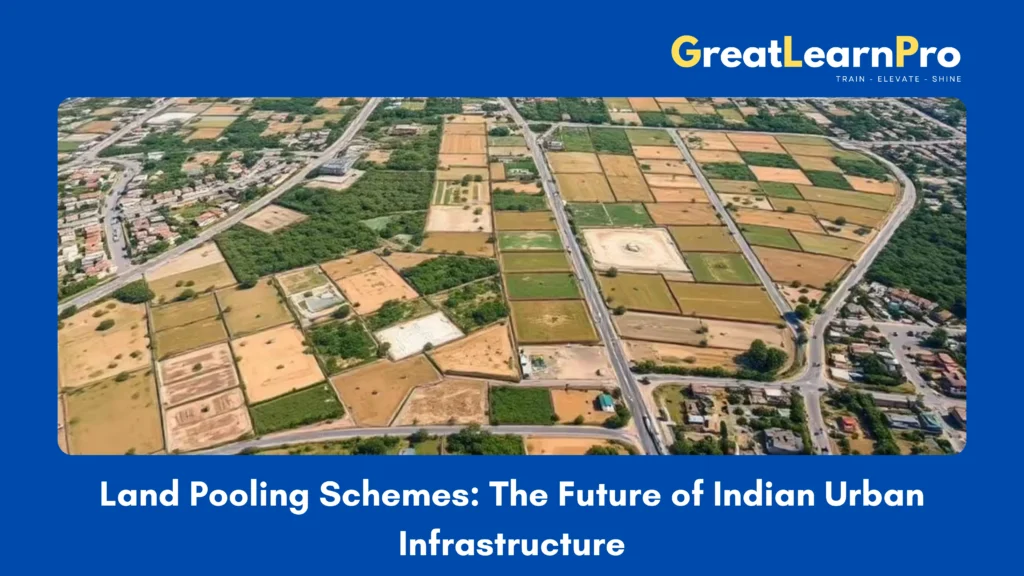
Imagine owning a piece of land on the fringes of a rapidly growing Indian city. It is a valuable asset, but currently, it has no access roads, no clean water supply, and no electricity grid. One day, the government decides to build a major highway right through your neighborhood. Historically, this meant only one thing: compulsory land acquisition. Your land would be taken, you would receive a cash payout after a lengthy legal battle, and you would be forced to move elsewhere.
Today, a quiet revolution is taking place across India’s Urban Infrastructure Development. From Gujarat to Rajasthan, states are shifting away from this disruptive, top-down approach. Instead, they are embracing Land Pooling—a collaborative, participatory model where landowners become active partners in urban growth rather than victims of displacement.
The Breaking Point of Traditional Land Acquisition
For decades, urban infrastructure projects in India relied heavily on state-enforced land acquisition. However, this process became financially crippling and procedurally broken, especially after the introduction of the Right to Fair Compensation and Transparency in Land Acquisition, Rehabilitation and Resettlement Act, 2013.
While the 2013 Act brought much-needed fairness and strict rehabilitation mandates for displaced families, it also created immense structural challenges for urban development authorities:
- Skyrocketing Costs: The financial obligations for compensation, rehabilitation, and resettlement made large-scale land buying fiscally unviable for cash-strapped municipalities.
- Endless Litigation: Disagreements over land valuation routinely ended up in courts, delaying critical highway, metro, and housing projects for years.
- The Execution Gap: Because cities could not mobilize land quickly or affordably, a massive gap formed between master plans on paper and actual infrastructure on the ground.
Faced with this bottleneck, planners needed a model where land could be developed without forcing the government to buy it outright.
Enter Land Pooling: How the Model Works
Land pooling completely flips the script on development. Instead of forcing you to sell your property, the government asks you to join a partnership.
- Voluntary Pooling: Landowners temporarily surrender their irregular, scattered plots to a local development authority.
- Infrastructure Injection: The authority treats the entire area as a single canvas. It lays down wide roads, sewage lines, electricity networks, parks, and civic amenities.
- The Reconstituted Return: The authority takes a percentage of the land (typically 25% to 45%) to build this infrastructure and fund the project. The remaining portion (55% to 75%) is returned to the original owners.
The magic lies in the economics. Even though your returned plot is physically smaller than your original piece of land, its market value skyrockets because it is now a fully serviced, perfectly shaped, accessible urban plot.
The Pioneer: Gujarat’s Town Planning (TP) Success
Land pooling is not a brand-new experiment; it has a century of proof behind it. Gujarat pioneered this through its Town Planning (TP) Schemes, formalized under the Gujarat Town Planning and Urban Development Act, 1976.
Over the last few decades, Gujarat has successfully planned more than 1,000 square kilometers across Ahmedabad, Surat, Rajkot, Vadodara, and Gandhinagar using TP schemes. Landowners contribute around 25% to 40% of their plots. In return, they get back premium real estate, while the city gains space for public parks, schools, and low-income housing. The model is entirely self-sustaining: the city sells a few residual plots to cover construction costs, requiring zero upfront taxpayer money.
While Maharashtra initially lagged behind in updating its laws, powerhouse regions like Pune and the Mumbai Metropolitan Region Development Authority (MMRDA) are actively reviving land pooling to manage growth along their chaotic outer edges.
Local Innovation: How Other States are Adapting
A single urban planning model cannot fit a country as diverse as India. The real success of land pooling depends on localized innovation and institutional flexibility. Recent rollouts show how states are customizing the blueprint:
- Rajasthan’s Equitable Calculations
Rajasthan recently announced its very first land pooling scheme to jumpstart stalled infrastructure projects. Recognizing their lack of prior experience, the state government made a smart, empathetic pivot: they modified local land-value calculations. By absorbing a portion of the development costs internally, the government reduced the financial burden on local landowners, making the scheme immediately attractive and highly equitable.
- Guwahati’s Tech-Smarter Shortcuts
When Guwahati tried to implement development schemes under its 1985 Act, it hit a brick wall. The city lacked digitized land records, and manual papers did not match actual ground realities. Instead of wasting years on tedious field surveys, the city made a bold administrative choice: they accepted existing revenue maps as absolute truth for allocation. To win public trust, they slashed the required private land contribution down to just 12% to 15%, using it strictly for vital road networks.
- The Next Frontier: Delhi, Tamil Nadu, and Madhya Pradesh
States just entering the land pooling arena face a steep hill: the psychological barrier. Their primary challenge is clear communication. They must actively engage with communities, clearly demonstrate the long-term wealth generation of serviced land, and write transparent laws that protect small farmers from corporate exploitation.
A Win-Win-Win Scenario for Urban Growth
- For Landowners: The biggest fear of any property owner is displacement. Land pooling completely eliminates this anxiety by allowing families to retain a stake in their ancestral neighborhoods. Instead of a one-time cash payout that quickly loses value, owners witness an immediate jump in their net worth as their raw land transforms into a premium, highly accessible urban plot.
- For the Government: Local municipalities are freed from the crippling burden of upfront acquisition costs. By avoiding massive compensation payouts and bypassing endless court battles, city planners can execute major projects on accelerated timelines without straining the public treasury.
- For the Environment: Instead of allowing cities to fragment into chaotic, unplanned concrete jungles, land pooling introduces order. It guarantees that dedicated green spaces, wide roads, and public parks are woven directly into the neighborhood fabric right from the very beginning.
Charting the New Course
Land pooling is transforming Indian urban planning from a system of state confrontation into a model of community collaboration. By transforming private citizens into active stakeholders in progress, cities can build the world-class highways, utilities, and public spaces they desperately need.
The success of India’s next urban chapter will not depend on heavy-handed laws, but on creative, flexible, and human-centric models like land pooling.
Sources Referred:
- The Hindu: https://www.thehindu.com/opinion/op-ed/how-land-pooling-solves-acquisition-woes/article71054299.ece
- Jaipur Development Authority: https://jda.rajasthan.gov.in/content/raj/udh/jda—jaipur/en/notice-board/land-pooling-scheme.html
- Rajasthan Urban Development and Housing (UDH) Department: https://udh.rajasthan.gov.in/content/raj/udh/udh-department/en/act-and-rules.html
- The Hindu Parliament Budget Session Coverage: https://www.thehindu.com/news/national/parliament-budget-session-highlights-lok-sabha-rajya-sabha-march-23-2026/article70774463.ece
More Current Affairs: https://greatlearnpro.com/updates/