
The Vizag Steel Plant Blast: Industrial Safety, Legal Accountability, and the Human Cost
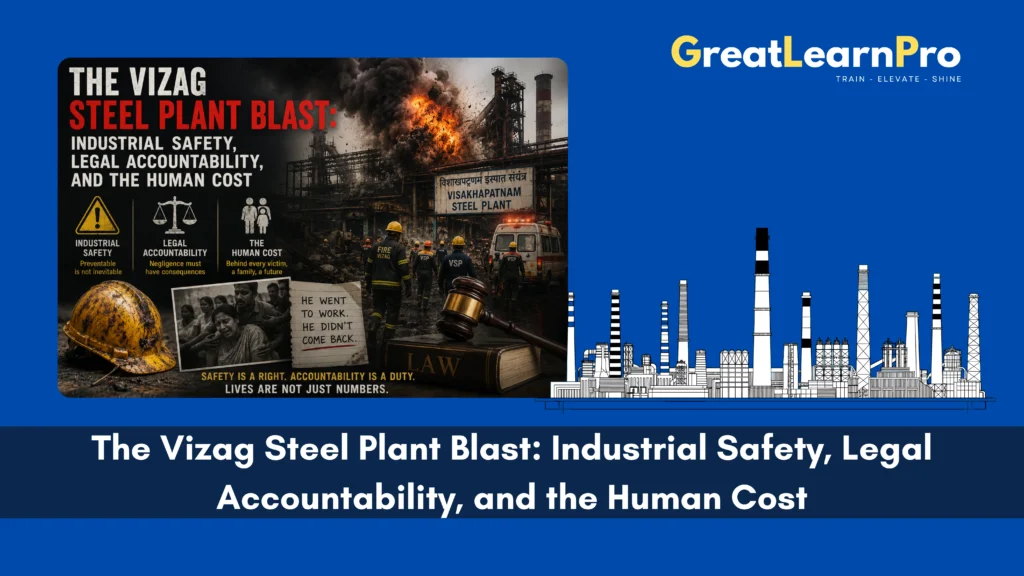
The industrial city of Visakhapatnam was thrown into deep mourning following a catastrophic ladle explosion at the Rashtriya Ispat Nigam Limited (RINL) Visakhapatnam Steel Plant (VSP). At the Steel Melt Shop-1 (SMS-1), molten crude steel heated to a blinding 1,500 degrees Celsius erupted just before a slide gate could open.
The resulting fireball claimed nine lives, left workers battling horrific burns, and reignited a fierce national debate: Are Indian industrial safety standards keeping pace with economic growth?
Understanding the Tragedy: A Technical and Systemic Failure
On that fateful evening, a high-intensity blast ripped through Caster-2, trapping overhead crane operators and ground staff under a torrent of liquid metal. Preliminary reports indicate the blast stemmed from a gas build-up inside the ladle.
However, workers’ unions quickly pointed out that minor flashes had occurred less than an hour earlier. They allege that corporate cost-cutting, structural negligence, and staff shortages caused critical warnings to be ignored.
[Gas Accumulation in Ladle] ➔ [Sudden Pressure Spike] ➔ [Catastrophic Explosion] ➔ [Total Caster Failure]
To uncover the root cause, a high-level external expert committee headed by Priya Ranjan (Director in-charge, Bokaro Steel Plant) was dispatched alongside top safety minds from SAIL. Simultaneously, RINL initiated an internal technical inquiry to investigate the exact process failure.
The Legal Framework: From Negligence to Absolute Liability
When industrial disasters strike in India, the legal framework shifts from basic negligence to strict, uncompromising accountability. For decades, the Indian judiciary has built a robust wall of case laws to protect workers and surrounding communities.
- The Doctrine of Absolute Liability
Unlike Western legal systems that allow corporations to use the “Act of God” or third-party interference defense (Strict Liability), the Indian Supreme Court established the Doctrine of Absolute Liability in the landmark M.C. Mehta v. Union of India (1987) case (Oleum Gas Leak).
Under this doctrine, if an enterprise engages in an inherently dangerous or hazardous activity (like handling 1,500°C molten steel) and harm results, the enterprise is strictly and absolutely liable to compensate all those affected. The company cannot claim the accident was unavoidable or unforeseen.
- Right to Health and Safe Working Environments
In Consumer Education & Research Centre (CERC) v. Union of India (1995), the Supreme Court expanded the definition of Article 21 (Right to Life). The court ruled that the right to health and a safe working environment is a fundamental right for every worker.
The state and public sector undertakings like RINL have a constitutional obligation to enforce proactive safety protocols, regular machine maintenance, and structural safety audits.
Historical Precedents: Relief vs. Reality
To truly evaluate the response to the Vizag blast, we must look at how past industrial disasters were handled in India and how compensation models have evolved over time.
The Bhopal Gas Tragedy (1984)
The mass leakage of toxic Methyl Isocyanate gas due to systemic safety cuts remains India’s darkest industrial hour. In this case, the legal battle dragged on for years, resulting in heavily delayed and severely diluted payouts of roughly ₹25,000 per victim across a prolonged timeline. However, this tragedy set up the historical push toward the Absolute Liability doctrine to prevent future corporate exits.
The LG Polymers Styrene Gas Leak (2020)
Caused by poor maintenance of chemical storage tanks during a lockdown, this leak led to swift legal action. The National Green Tribunal (NGT) strictly applied the Absolute Liability doctrine and ordered a ₹50 crore interim deposit for environmental damages. Families of the deceased received ₹1 crore alongside dedicated medical funds for survivors.
The Vizag Steel Plant Blast
In comparison to past tragedies, the relief package announced for the Vizag Steel Plant victims is substantial and fast-tracked. Union Steel Minister H.D. Kumaraswamy declared an immediate ₹25 lakh ex gratia, a permanent job at RINL for the next of kin, and full educational backing for the victims’ children. When statutory benefits and insurance are factored in, permanent employees’ families will receive roughly ₹1.72 crore, while contract workers will receive between ₹40 lakh and ₹45 lakh.
The Contract Worker Disparity: A Glaring Legal Gap
While the financial relief package shows an empathetic response, it brings to light a troubling double standard within industrial law: the divide between permanent and temporary contract workers.
Contract workers like Trinadh, Appalaraju, and Ramana faced identical hazards at Caster-2, yet their families will receive a fraction of the terminal benefits given to permanent staff. Under the Contract Labor (Regulation and Abolition) Act, 1970, principal employers are technically responsible for the welfare of contract laborers. However, in practice, insurance caps and structural rules heavily penalize temporary labor, leaving them financially vulnerable despite suffering the exact same consequences on the factory floor.
Safety Cannot Be a Paper-Only Policy
The tragic explosion at the Visakhapatnam Steel Plant serves as a stark reminder that industrial safety cannot be treated as a checkbox exercise. The Priya Ranjan committee’s impending report must look past mere technical failure and audit the safety culture of the plant.
True justice for the nine workers lost at SMS-1 will not be achieved simply by transferring funds to their grieving families. It will be achieved when India’s heavy manufacturing units move from post-disaster compensation to proactive, preventative risk management. Safe working environments are a fundamental right, and factory floors must never be run at the cost of human lives.
Sources Referred:
- The Hindu – https://www.thehindu.com/news/cities/Visakhapatnam/high-level-probe-into-blast-at-visakhapatnam-steel-plant-begins/article71081074.ece
- The New Indian Express – https://www.newindianexpress.com/amp/story/states/andhra-pradesh/2026/Jun/10/gas-build-up-may-be-cause-of-steel-plant-blast-preliminary-factory-report
More Current Affairs: https://greatlearnpro.com/updates/