
NCDs Account for 60% of Deaths in India: A Growing Public Health Challenge Across Urban and Rural Communities
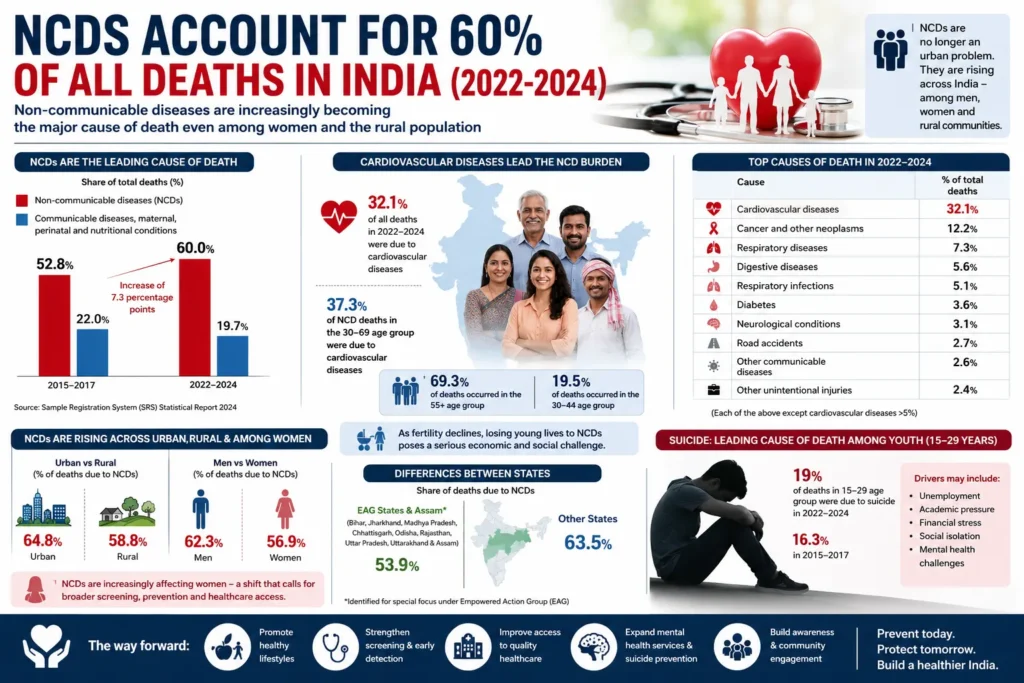
India’s health landscape is undergoing a profound transformation. According to the recently released Sample Registration System (SRS) Statistical Report 2024, non-communicable diseases (NCDs) now account for 60% of all deaths in the country during the 2022–2024 reporting period. This marks a significant increase from 52.8% in 2015–2017, highlighting a major shift in the nation’s disease burden.
The findings underscore an urgent reality: chronic illnesses such as heart disease, cancer, diabetes, and respiratory disorders are increasingly becoming the leading causes of death—not only in urban populations but also among women and rural communities.
India’s Epidemiological Transition
For decades, infectious diseases, maternal health complications, and nutritional deficiencies dominated India’s mortality profile. However, the latest data reveal that India is experiencing an epidemiological transition, similar to that seen in many middle- and high-income countries.
While communicable diseases and maternal, perinatal, and nutritional conditions accounted for 22% of all deaths in 2015–2017, their share declined to 19.7% in 2022–2024. At the same time, NCDs have continued to rise, becoming the predominant cause of mortality across the country.
This shift reflects changes in lifestyle, urbanization, dietary patterns, environmental factors, and an ageing population. Yet it also presents a major challenge for healthcare systems that must simultaneously tackle infectious diseases and chronic conditions.
Cardiovascular Diseases Lead the Crisis
Among all non-communicable diseases, cardiovascular diseases (CVDs) remain the most significant threat. The report shows that heart-related conditions accounted for 32.1% of all deaths in 2022–2024, up from 27.1% in 2015–2017.
Even more concerning is their impact on the working-age population. In the 30–69 age group, cardiovascular diseases accounted for 37.3% of all deaths, indicating that heart disease is no longer confined to older adults.
Health experts have increasingly warned that heart attacks, hypertension, and other cardiovascular conditions are affecting people in their 30s and 40s. The loss of individuals in their most productive years carries significant economic and social consequences for families and the nation alike.
Premature Mortality: An Emerging Concern
Although the majority of deaths (69.3%) occurred among individuals aged 55 years and above, nearly one in five deaths (19.5%) occurred among people aged 30–44 years.
As India’s fertility rate continues to decline—with several states already below the replacement level of 2.1 children per woman—the loss of working-age adults poses serious challenges. Premature mortality reduces workforce participation, affects household incomes, and increases the burden on social and healthcare systems.
NCDs Are No Longer an Urban Problem
Historically, chronic diseases were viewed primarily as an urban phenomenon. The latest data challenge that perception.
While NCDs accounted for 64.8% of deaths in urban areas, they were responsible for 58.8% of deaths in rural areas as well. This demonstrates that rural populations are increasingly experiencing the same health risks traditionally associated with cities.
Factors contributing to this trend include:
- Increased consumption of processed foods
- Sedentary lifestyles
- Tobacco and alcohol use
- Rising obesity rates
- Limited access to preventive healthcare and early diagnosis
The growing prevalence of NCDs in rural India highlights the need for stronger primary healthcare systems and community-based prevention programs.
The Rising Burden Among Women
The report also reveals important gender-related trends.
NCDs accounted for 62.3% of all deaths among men and 56.9% among women. While the burden remains slightly higher among men, the increasing share among women is significant.
Women’s health discussions in India have traditionally focused on reproductive and maternal health. However, the growing impact of heart disease, cancer, diabetes, and respiratory illnesses among women calls for broader health strategies that address chronic disease prevention, screening, and treatment throughout a woman’s life.
Cancer, Respiratory Diseases, and Diabetes Continue to Rise
After cardiovascular diseases, several other chronic conditions emerged as major causes of death:
- Cancer and other neoplasms
- Respiratory diseases
- Digestive diseases
- Diabetes
- Respiratory infections
Each of these categories accounted for more than 5% of all deaths during the reporting period.
The increasing prevalence of these diseases reflects changing lifestyles, environmental pollution, tobacco use, and ageing demographics. Early detection and preventive care will be critical in reducing their impact.
India’s Double Burden of Disease
Despite the rise of NCDs, infectious diseases have not disappeared.
Public health experts describe India’s situation as a “double burden” of disease, where the country must simultaneously manage:
- Persistent infectious diseases and public health challenges.
- Rapidly increasing chronic illnesses.
This dual challenge places immense pressure on healthcare infrastructure, funding, and workforce capacity. Policymakers must balance investments in disease prevention, vaccination, maternal health, and infectious disease control while expanding services for chronic disease management.
Mental Health and Suicide: A Growing Crisis Among Youth
One of the most alarming findings in the report concerns young people.
Suicide remains the leading cause of death among individuals aged 15–29 years. Suicides accounted for 19% of deaths in this age group, up from 16.3% in 2015–2017.
The increase reflects growing mental health challenges linked to:
- Academic pressure
- Unemployment
- Financial stress
- Social isolation
- Relationship issues
- Digital and social media influences
These findings reinforce the need for stronger mental health services, counseling support, suicide prevention programs, and efforts to reduce stigma around seeking help.
Regional Differences Remain Significant
The report also highlights disparities between the Empowered Action Group (EAG) States and Assam—including Bihar, Jharkhand, Madhya Pradesh, Chhattisgarh, Odisha, Rajasthan, Uttar Pradesh, Uttarakhand, and Assam—and the rest of India.
In EAG States and Assam:
- NCDs accounted for 53.9% of all deaths
In other States:
- NCDs accounted for 63.5% of all deaths
While the burden is lower in EAG States, the upward trend is unmistakable. As these states continue to develop and urbanize, they may witness further increases in chronic disease prevalence unless preventive measures are strengthened.
The Road Ahead
The SRS Statistical Report 2024 paints a clear picture: India is entering a new phase in its public health journey. Non-communicable diseases are no longer diseases of affluence or urban living. They have become the leading cause of death across regions, genders, and age groups.
Addressing this challenge requires a comprehensive strategy focused on:
- Promoting healthy lifestyles
- Encouraging regular health screenings
- Strengthening primary healthcare systems
- Expanding access to chronic disease management
- Improving mental health services
- Enhancing awareness about risk factors such as smoking, unhealthy diets, and physical inactivity
The rise of NCDs is not merely a healthcare issue—it is a social and economic challenge that will shape India’s future development. The time for preventive action is now, before the burden grows even heavier in the decades ahead.
Conclusion
The latest mortality data serve as a stark reminder that India’s health priorities are changing. With 60% of all deaths now linked to non-communicable diseases, policymakers, healthcare providers, and citizens must work together to prevent, detect, and manage chronic illnesses more effectively. The nation’s ability to safeguard its workforce, improve quality of life, and sustain economic growth will depend significantly on how it responds to this emerging public health reality.
More Current Affairs: https://greatlearnpro.com/updates/