
The Goat’s Leap into a Legal Storm: Understanding the Mekedatu Dam Dispute
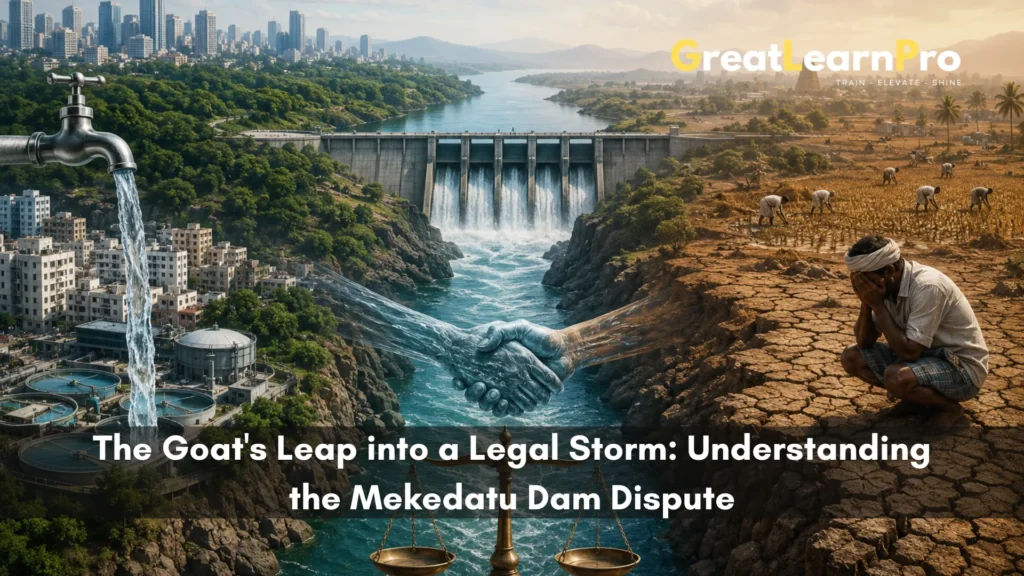
Nestled amidst the forests of southern Karnataka, approximately 100 kilometers from Bengaluru, lies Mekedatu—literally meaning “Goat’s Leap” in Kannada. Known for its dramatic rocky gorge and breathtaking landscape, this stretch of the Cauvery River has long been a popular destination for tourists and nature enthusiasts. Yet today, Mekedatu is at the center of one of India’s most contentious inter-state water disputes.
The proposed Mekedatu Balancing Reservoir Project by the Karnataka government has reignited decades-old tensions between Karnataka and Tamil Nadu over the sharing of Cauvery waters. What Karnataka views as a critical solution to Bengaluru’s growing water crisis, Tamil Nadu perceives as a threat to the water security of millions of farmers dependent on the Cauvery delta.
The dispute goes far beyond a dam. It raises larger questions about federalism, environmental sustainability, urbanization, water governance, and the ability of Indian institutions to manage increasingly scarce natural resources in a changing climate.
What is the Mekedatu Project?
The Mekedatu project was first conceptualized by Karnataka as a multipurpose reservoir on the Cauvery River near the Karnataka-Tamil Nadu border.
The proposed project includes:
- A 99-meter-high concrete gravity dam.
- A balancing reservoir capable of storing approximately 67 TMC of water.
- Supply of nearly 4.75 TMC of drinking water annually to Bengaluru and surrounding regions.
- Generation of approximately 400 MW of hydroelectric power.
Karnataka estimates the project cost to range between ₹9,000 crore and ₹14,000 crore.
Unlike large irrigation dams, Karnataka argues that Mekedatu is primarily designed as a drinking water project. The state contends that the reservoir would store excess monsoon flows that would otherwise continue downstream and eventually flow into the sea.
For Bengaluru—a city grappling with declining groundwater levels, shrinking lakes, and rising water demand—the project is projected as a long-term water security measure.
Why Does Karnataka Support the Project?
Karnataka’s support for the project stems largely from concerns regarding urban growth and water scarcity.
Bengaluru’s Water Challenge
Bengaluru has transformed into one of India’s largest metropolitan regions and a global technology hub. However, rapid urbanization has significantly increased water demand.
The city faces several challenges:
- Depleting groundwater reserves.
- Loss of traditional lakes and wetlands.
- Rising population pressures.
- Dependence on Cauvery water transported over long distances.
According to Karnataka, the Mekedatu reservoir would help ensure a stable drinking water supply for future generations.
Hydropower Benefits
The project also promises 400 MW of hydroelectric power generation. In an era where states are seeking cleaner energy sources, Karnataka argues that hydropower can contribute to energy security while reducing dependence on fossil fuels.
Better Water Regulation
State authorities maintain that a balancing reservoir would allow more efficient management of water releases during both normal and distress years, helping regulate downstream flows rather than disrupting them.
Why Does Tamil Nadu Oppose the Project?
Tamil Nadu’s opposition is rooted in history, geography, and trust.
Dependence on Cauvery Waters
The Cauvery delta is often called the “Rice Bowl of Tamil Nadu.” Millions of farmers depend on river water for irrigation, particularly for paddy cultivation.
Any reduction in water availability can have serious consequences for:
- Agricultural productivity.
- Rural livelihoods.
- Food security.
- Regional economic stability.
Fear of Upstream Control
Tamil Nadu’s primary concern is not merely the construction of a reservoir but the possibility of increased upstream control over river flows.
The proposed dam site lies only a few kilometers upstream of the state border. Tamil Nadu fears that during years of inadequate rainfall, Karnataka may prioritize filling its own reservoir before releasing water downstream.
This concern is amplified by decades of disputes over water releases and recurring allegations of non-compliance during drought years.
Trust Deficit
At the heart of the controversy lies a deep trust deficit.
Even though Karnataka assures compliance with judicial allocations, Tamil Nadu remains skeptical that additional storage infrastructure will not affect downstream water availability in practice.
The Legal History of the Cauvery Dispute
The Mekedatu issue cannot be understood without examining the larger Cauvery water dispute.
The conflict dates back more than a century and involves competing claims over river waters between Karnataka, Tamil Nadu, Kerala, and Puducherry.
Key milestones include:
Cauvery Water Disputes Tribunal
The tribunal was established under the Inter-State River Water Disputes Act, 1956, to determine water-sharing arrangements.
After years of hearings, the tribunal issued its final award in 2007.
Supreme Court Judgment of 2018
In 2018, the Supreme Court delivered a landmark judgment modifying the tribunal’s award.
The Court allocated:
- 284.75 TMC to Karnataka.
- 404.25 TMC to Tamil Nadu.
- Shares to Kerala and Puducherry.
Importantly, Karnataka was directed to ensure the release of 177.25 TMC of water annually to Tamil Nadu at the interstate border under normal conditions.
The judgment also led to the establishment of the Cauvery Water Management Authority (CWMA) and the Cauvery Water Regulation Committee (CWRC) for implementation and monitoring.
The Supreme Court’s Position on Mekedatu
In May 2026, the Supreme Court delivered a significant decision regarding the Mekedatu project.
The Court dismissed Tamil Nadu’s challenge and described its objections as premature.
The judiciary clarified that:
- Preparation or revision of a Detailed Project Report (DPR) does not amount to actual construction.
- Regulatory agencies should first assess the technical and environmental aspects.
- Specialized institutions such as the Central Water Commission (CWC) and the CWMA should evaluate the proposal before judicial intervention.
At the same time, the Court reiterated that Karnataka remains legally obligated to comply with water-sharing allocations regardless of whether the project is eventually approved.
This position reflects judicial preference for allowing expert bodies to evaluate technical matters before courts intervene.
Environmental Concerns Surrounding the Project
The dispute is not solely about water sharing.
Environmental groups have raised several concerns.
Impact on Forest Ecosystems
The proposed reservoir area falls within ecologically sensitive forest regions that support diverse wildlife.
Environmentalists warn of:
- Habitat fragmentation.
- Loss of forest cover.
- Disturbance to wildlife corridors.
- Impact on biodiversity.
River Ecology
Large reservoirs often alter natural river flow patterns.
Potential concerns include:
- Changes in sediment transport.
- Effects on aquatic ecosystems.
- Altered seasonal flow regimes.
- Long-term ecological consequences downstream.
Climate Change Considerations
Climate change is making rainfall increasingly unpredictable.
Both extreme floods and severe droughts are becoming more frequent.
Critics argue that future water planning should prioritize watershed restoration, groundwater recharge, lake rejuvenation, and demand management alongside large infrastructure projects.
Federalism on Trial
The Mekedatu dispute has emerged as a test of India’s model of cooperative federalism.
The Constitution envisages collaboration between states and the Union government in managing shared natural resources. However, river disputes often expose competing developmental priorities.
For Karnataka, the issue is about:
- Urban water security.
- Infrastructure development.
- Economic growth.
For Tamil Nadu, it is about:
- Agricultural survival.
- Historical water rights.
- Protection of downstream interests.
Balancing these competing concerns requires institutions capable of building trust and ensuring transparency.
The Road Ahead
The future of the Mekedatu project now rests with multiple regulatory processes.
Key decisions remain pending regarding:
- Environmental clearances.
- Technical feasibility assessments.
- Central Water Commission approvals.
- Cauvery Water Management Authority recommendations.
Even if approvals are granted, political negotiations between the states will remain essential.
The dispute demonstrates that legal judgments alone cannot fully resolve water-sharing conflicts. Sustainable solutions require scientific assessment, transparent governance, and cooperative dialogue.
Conclusion
The Mekedatu Dam dispute represents far more than a disagreement over a single infrastructure project. It encapsulates the broader challenges confronting India in the twenty-first century—urban expansion, water scarcity, environmental conservation, climate uncertainty, and inter-state relations.
Karnataka views the project as a necessary investment in Bengaluru’s future water security, while Tamil Nadu sees it as a potential threat to the livelihoods of millions dependent on Cauvery waters. Both concerns are legitimate, reflecting the difficult choices that arise when finite natural resources must serve competing needs.
As regulatory agencies continue their evaluation, Mekedatu remains a crucial test of India’s ability to balance development with sustainability and federal cooperation with regional interests. The ultimate resolution of this dispute may well shape the future framework for managing inter-state rivers across the country.
Sources Referred:
- Ministry of Jal Shakti – https://www.jalshakti-dowr.gov.in
- Central Water Commission (CWC) – https://cwc.gov.in
- Cauvery Water Management Authority (CWMA) – https://www.jalshakti-dowr.gov.in
- Legislative Department – Inter-State River Water Disputes Act, 1956 – https://www.legislative.gov.in
More Current Affairs: https://greatlearnpro.com/updates/