
The Guardians and the Gatekeepers: Unpacking the EC, CEC, and SIR in 2026
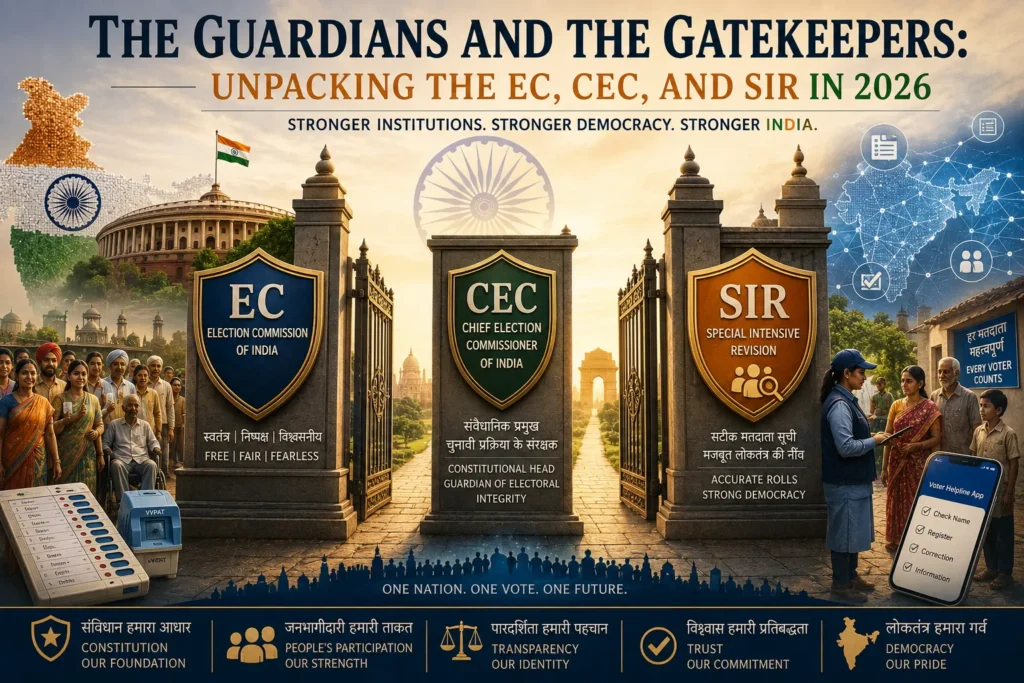
As India navigates the 2026 electoral cycle, the focus of legal discourse has shifted toward the procedural integrity of the vote. For keen observers, understanding the current status of the Election Commission (EC), the evolution of appointment laws, and the mechanics of roll purification is essential to evaluating the strength of our democratic institutions.
-
The Election Commission: A Constitutional Mandate
The Election Commission of India (ECI) operates under the expansive umbrella of Article 324. Historically, the Supreme Court has described this power as “plenary,” meaning it fills the gaps where the law is silent to ensure free and fair elections.
In the current 2026 cycle, the EC has focused on “Electoral Integrity” through:
- Enforcement of the Model Code of Conduct (MCC): Managing the balance between free speech and fair play.
- Resource Management: Deploying unprecedented levels of central forces and digital monitoring to prevent electoral malpractice.
-
The CEC and EC Appointment Process: The New Legal Regime
Perhaps the most significant legislative change in recent years is the Chief Election Commissioner and Other Election Commissioners (Appointment, Conditions of Service and Term of Office) Act, 2023.
The Framework:
The Act formalized the selection process that was previously governed by executive convention. Under the new law, a Search Committee (headed by the Cabinet Secretary) prepares a shortlist, which is then sent to a Selection Committee.
- Composition: The Committee consists of the Prime Minister, the Leader of the Opposition (or leader of the largest party), and a Union Cabinet Minister.
- The Legal Debate: The judiciary is currently examining the exclusion of the Chief Justice of India (CJI) from this panel. While the government maintains that the legislature has the sole prerogative to frame the selection law under Article 324(2), petitioners argue that institutional independence requires a neutral “third-party” arbiter like the CJI.
-
Special Intensive Revision (SIR): The Mechanics of “Purification”
The Special Intensive Revision (SIR) is a rigorous administrative exercise distinct from the routine Annual Summary Revision. Its objective is to ensure the “purity of the rolls” by eliminating duplicate entries, deceased voters, and permanent shiftings.
Legal and Procedural Aspects:
- Field Verification: Booth Level Officers (BLOs) conduct door-to-door visits to verify residency.
- Due Process: Under the Representation of the People Act, 1950, the EC must provide a reasonable opportunity for a voter to be heard before their name is deleted.
- Current Status: In states like West Bengal and Uttar Pradesh, the 2025-26 SIR led to the removal of millions of entries. While the EC categorizes this as “administrative cleaning” to prevent electoral fraud, legal challenges often arise regarding whether the “Notice of Deletion” was adequately served to the individual.
-
The Role of the Judiciary in 2026
The Indian judiciary continues to act as a watchdog over the electoral process without interfering in the “conduct of elections” (as per Article 329).
- Voter Reinstatement: Courts have recently focused on the “Right to Vote” as a fundamental expression of citizenship, intervening in cases where procedural errors led to mass disenfranchisement.
- Transparency: The judiciary’s push for transparency in political funding and the appointment process remains a defining theme of this year’s legal landscape.
Conclusion
The interplay between the ECI’s administrative powers, the new appointment statutes, and the intensive revision of voter data represents the “checks and balances” of the Indian state. For legal practitioners, the goal is to ensure that while the machinery of the EC remains efficient and empowered, it operates strictly within the bounds of natural justice and constitutional propriety.
Sources referred:
- Election Commission of India: https://www.eci.gov.in/about-eci
- The Hindu: https://www.thehindu.com/news/national/ex-bureaucrats-sukhbir-sandhu-gyanesh-kumar-named-election-commissioners/article67949991.ece
- The New Indian Express: https://www.newindianexpress.com/nation/2026/May/07/sc-hears-challenge-to-ec-appointment-law-as-congress-alleges-rushed-selection-of-gyanesh-kumar-sandhu
- The Indian Express: https://indianexpress.com/article/explained/explained-law/election-commission-sc-challenge-appointment-process-10679037/
More Current Affairs: https://greatlearnpro.com/updates/