
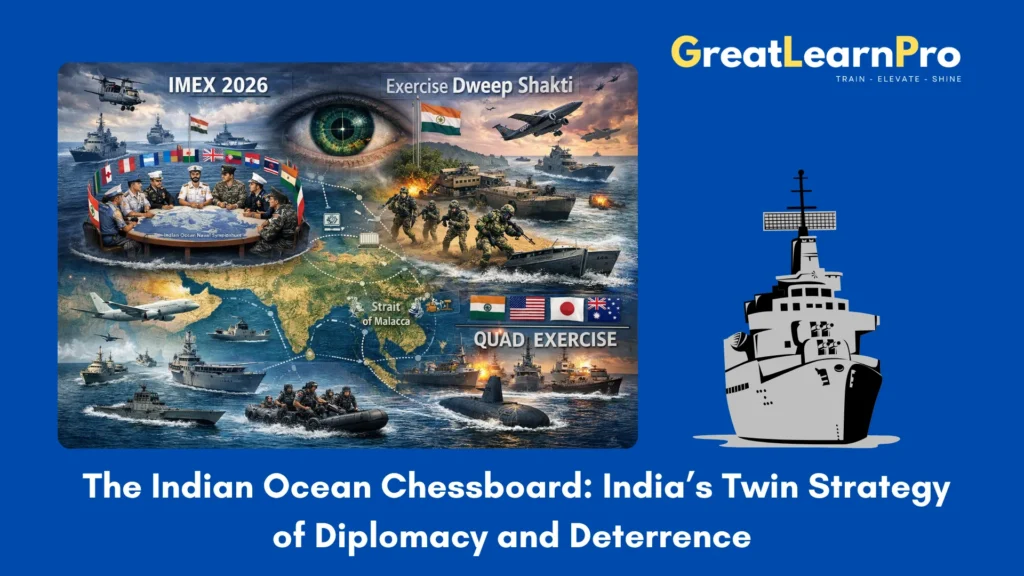
In the quiet stretches of the Indian Ocean, a sophisticated game of strategy is unfolding. While the average citizen might see the ocean as a vast, unchanging blue, the recent conclusion of the IONS Maritime Exercise (IMEX) 2026 and Exercise Dweep Shakti tells a different story. These aren’t just routine drills; they are a calculated statement of intent in a region that is rapidly becoming the world’s most critical geopolitical theater.
The Diplomatic Anchor: IMEX 2026
In Kochi, the Indian Navy recently hosted the table-top edition of the Indian Ocean Naval Symposium (IONS) exercise. What makes this significant isn’t just the tactical discussions, but the diplomatic weight behind them. With India assuming the IONS Chairmanship (2026–2028), it is positioning itself as a “Net Security Provider.”
Unlike traditional war games, IMEX focuses on non-traditional threats- piracy, maritime terrorism, and the legal complexities of trafficking in international waters. By bringing 12 nations to the table, India is building a “rules-based order” at sea, a critical shield against the rising tide of lawlessness that often bypasses traditional borders.
The Strategic Shield: Dweep Shakti
If IMEX is the velvet glove of diplomacy, Exercise Dweep Shakti is the iron fist of readiness. Conducted in the strategic Andaman and Nicobar archipelago, this tri-service operation validated India’s ability to defend its “island citadels.”
The location is no accident. These islands sit at the doorstep of the Strait of Malacca, a chokepoint through which much of the world’s energy and trade flows. By integrating the Army, Navy, and Air Force into a single cohesive unit, the Andaman and Nicobar Command (ANC) demonstrated that India can not only monitor these vital lanes but also protect its territorial integrity against any rapid-onset threat.
The Horizon: A Constant Watch
These events do not exist in isolation. They are part of a broader “security audit” of our maritime frontiers, joining the ranks of other essential maneuvers:
Exercise MILAN: A massive biennial gathering that acts as a forum for naval cooperation among dozens of countries.
Exercise SEA VIGIL: A pan-India coastal defense drill that tests the “last mile” of security along our 7,500km coastline.
Exercise MALABAR: The high-stakes engagement between the QUAD nations (India, US, Japan, Australia), focused on ensuring a free and open Indo-Pacific.
For the modern observer, these exercises highlight a fundamental shift in national priority. Maritime security is no longer a peripheral concern; it is the foundation of economic stability. As trade increases and geopolitical tensions simmer, India’s “Blue Water” strategy, balancing the soft power of IONS with the hard power of Dweep Shakti, is the only way to ensure the Indian Ocean remains a zone of peace and prosperity.
Sources:
- The Times of India – https://timesofindia.indiatimes.com/videos/news/india-conducts-ex-dweep-shakti-tri-service-drill-to-boost-coastal-and-island-defence/videoshow/129940365.cms
- The Hindu – https://www.thehindu.com/news/national/indian-ocean-naval-symposium-holds-maiden-maritime-exercise/article65274711.ece
- Government Press Information Bureau (PIB): Releases regarding the Defence Budget 2026–27 and strategic posture. https://www.pib.gov.in/PressReleasePage.aspx?PRID=2246627®=3&lang=2
- Editorial Analyses: Expert commentary from platforms like Vajiram & Ravi regarding maritime security challenges in 2026. https://vajiramandravi.com/current-affairs/ions-maritime-exercise-imex/
More Current Affairs: https://greatlearnpro.com/updates/