
El Niño 2026: What a Strengthening Pacific Climate Phenomenon Means for India and the World
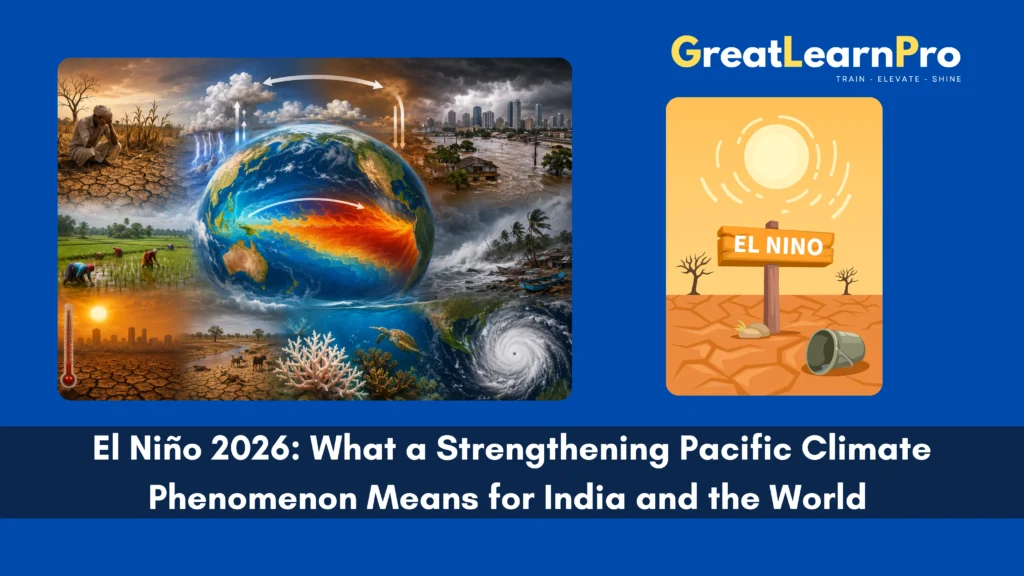
The confirmation of a new El Niño event by the U.S. National Oceanic and Atmospheric Administration (NOAA) has once again placed global climate systems under intense scrutiny. With forecasts suggesting a significant probability of this event strengthening into a “very strong” or “super” El Niño, concerns are growing over its potential impact on weather patterns, agriculture, food security, water resources, and economies worldwide.
For India, the timing is especially critical. The India Meteorological Department (IMD) has reported a substantial rainfall deficit during the early weeks of the southwest monsoon. Historically, El Niño years have often been associated with weaker monsoons, drought conditions, and economic disruptions. However, the relationship is not always straightforward, as other climate systems can either amplify or offset El Niño’s influence.
As climate change continues to warm the world’s oceans, understanding El Niño has become more important than ever. Its effects are no longer confined to the Pacific Ocean but ripple across continents, influencing rainfall, temperatures, tropical cyclones, ecosystems, and livelihoods.
What is El Niño?
El Niño is a naturally occurring climate phenomenon characterized by the unusual warming of sea surface temperatures in the central and eastern equatorial Pacific Ocean. It forms part of a larger climate cycle known as the El Niño-Southern Oscillation (ENSO), which alternates between:
- El Niño (warmer-than-average Pacific waters)
- La Niña (cooler-than-average Pacific waters)
- Neutral conditions
Under normal conditions, strong trade winds push warm surface waters westward toward Asia and Australia. During an El Niño event, these winds weaken, allowing warm water to accumulate in the eastern Pacific. This shift alters atmospheric circulation patterns across the globe.
Meteorologists classify El Niño events based on the extent of ocean warming:
- Weak: 0.5°C–1°C above average
- Moderate: 1°C–1.5°C
- Strong: 1.5°C–2°C
- Very Strong (Super El Niño): Above 2°C
Only a handful of El Niño events since the 1950s have crossed the 2°C threshold, making them relatively rare but highly influential climate events.
Why is the Current El Niño Attracting Attention?
Climate scientists and forecasting agencies are closely monitoring the current El Niño because projections indicate it could approach temperatures comparable to some of the strongest events in recorded history.
Past “super” El Niño events include:
- 1972–73
- 1982–83
- 1997–98
- 2015–16
These episodes produced significant climatic disruptions across the world, including severe droughts, floods, heatwaves, coral bleaching events, crop failures, and record-breaking global temperatures.
A major concern today is that climate change has increased baseline ocean temperatures. As a result, modern El Niño events are occurring in a warmer world, potentially making their impacts more intense than similar events in previous decades.
El Niño and India’s Monsoon: A Complicated Relationship
The Indian summer monsoon contributes nearly 70% of the country’s annual rainfall and remains the backbone of agriculture, water security, and rural livelihoods.
Historically, El Niño has often weakened the Indian monsoon. Since 1950, roughly two-thirds of El Niño years have recorded below-normal monsoon rainfall, while several have resulted in outright drought conditions.
Notable drought years linked to El Niño include:
- 1972
- 1982
- 1987
- 2002
- 2009
- 2015
The reason lies in atmospheric circulation. El Niño reduces the temperature difference between land and sea that helps drive monsoon winds toward the Indian subcontinent. Weaker monsoon circulation generally means reduced rainfall, particularly during the latter half of the monsoon season.
However, the relationship is not absolute.
Why El Niño Does Not Always Cause Drought in India
One of the most important moderating influences is the Indian Ocean Dipole (IOD), a climate phenomenon characterized by temperature differences between the western and eastern Indian Ocean.
A positive IOD can enhance monsoon rainfall and sometimes offset the drying influence of El Niño.
The most striking example occurred during the powerful 1997–98 El Niño. Despite being one of the strongest El Niño events ever recorded, India received slightly above-normal monsoon rainfall because a strong positive Indian Ocean Dipole counteracted the Pacific-induced drying effect.
This demonstrates why modern monsoon forecasting requires monitoring multiple ocean-atmosphere systems rather than relying solely on El Niño indicators.
Impact on Indian Agriculture and Economy
Agriculture remains highly dependent on monsoon rainfall despite improvements in irrigation infrastructure.
A weak monsoon can lead to:
- Reduced crop yields
- Lower reservoir levels
- Groundwater depletion
- Increased food inflation
- Higher rural distress
- Greater fiscal pressure on governments
Crops such as rice, pulses, sugarcane, cotton, and oilseeds are particularly vulnerable to rainfall deficits during critical growing periods.
The economic effects extend beyond agriculture. Reduced rural incomes can lower consumer spending, affect industrial demand, and influence overall economic growth.
For policymakers, the possibility of a deficient monsoon often triggers preparations involving food grain reserves, irrigation management, fertilizer distribution, and inflation control measures.
Global Consequences of El Niño
While India’s focus is understandably on the monsoon, El Niño is fundamentally a global climate phenomenon.
- Rising Global Temperatures
El Niño years are frequently among the warmest years ever recorded.
The 1998 and 2016 global temperature records were strongly influenced by powerful El Niño events.
When combined with long-term human-induced climate change, El Niño can push global temperatures to unprecedented levels, increasing the likelihood of heatwaves, wildfires, and ecosystem stress.
- Droughts Across Asia and Africa
El Niño often brings:
- Drier conditions to Australia
- Droughts in Indonesia
- Water shortages across Southeast Asia
- Crop failures in parts of Africa
The 2015–16 event contributed to severe drought and food insecurity affecting millions across eastern and southern Africa.
- Flooding in the Americas
While some regions experience drought, others receive excessive rainfall.
Countries along the Pacific coast of South America, particularly Peru and Ecuador, often witness:
- Heavy rainfall
- Flooding
- Landslides
- Infrastructure damage
This contrast highlights how El Niño redistributes weather extremes rather than simply making the world wetter or drier.
- Marine Ecosystem Disruptions
Warm ocean waters reduce nutrient upwelling in the Pacific Ocean, affecting fisheries and marine biodiversity.
One of the most visible impacts is coral bleaching.
The 1997–98 and 2015–16 El Niño events caused extensive coral mortality worldwide, including severe damage to Australia’s Great Barrier Reef.
Scientists estimate that the 1997–98 event alone contributed to the loss of a significant proportion of the world’s coral ecosystems.
El Niño and Tropical Cyclones
El Niño influences tropical cyclone activity globally.
Atlantic Ocean
El Niño tends to suppress Atlantic hurricanes by increasing vertical wind shear, which disrupts developing storms.
As a result, hurricane activity in the Atlantic basin often declines during strong El Niño years.
Pacific Ocean
The opposite occurs in parts of the Pacific.
Warmer waters and favourable atmospheric conditions increase the likelihood of powerful typhoons and hurricanes, particularly in the central and eastern Pacific.
Many of these storms eventually affect East Asia, Japan, the Philippines, and Pacific island nations.
Climate Change and the Future of El Niño
One of the most important scientific questions today is how climate change may alter El Niño behaviour.
Although researchers are still studying the exact relationship, several trends are emerging:
- Oceans are storing more heat than ever before.
- Marine heatwaves are becoming more frequent.
- Extreme weather events are increasing in intensity.
- Strong El Niño events may become more impactful even if their frequency remains unchanged.
A warmer atmosphere can hold more moisture, intensifying rainfall in some regions while worsening drought conditions in others.
This means future El Niño events may produce more pronounced climate extremes than those experienced in the twentieth century.
Conclusion
El Niño remains one of the most powerful drivers of global climate variability. Its influence stretches from Indian farms and African drought zones to Pacific coral reefs and Atlantic hurricane pathways.
For India, the concern is particularly acute because of the monsoon’s central role in agriculture, water security, and economic stability. While a strong El Niño increases the risk of below-normal rainfall, the final outcome will depend on the interaction of several climate systems, including the Indian Ocean Dipole and regional weather dynamics.
The broader lesson is clear: in an era of accelerating climate change, understanding and preparing for El Niño is no longer merely a meteorological exercise. It is a necessity for governments, businesses, farmers, and communities seeking to build resilience against an increasingly unpredictable climate future.
Sources Referred:
- India Meteorological Department (IMD) – https://mausam.imd.gov.in/imd_latest/contents/enso_bulletin.php
- National Oceanic and Atmospheric Administration (NOAA), United States – https://oceanservice.noaa.gov/facts/ninonina.html
- World Meteorological Organization (WMO) – https://wmo.int/news/media-centre/wmo-prepare-el-nino
More Current Affairs: https://greatlearnpro.com/updates/