
Telegram Ban During NEET 2026: A Necessary Step or a Symptom of a Deeper System Failure?
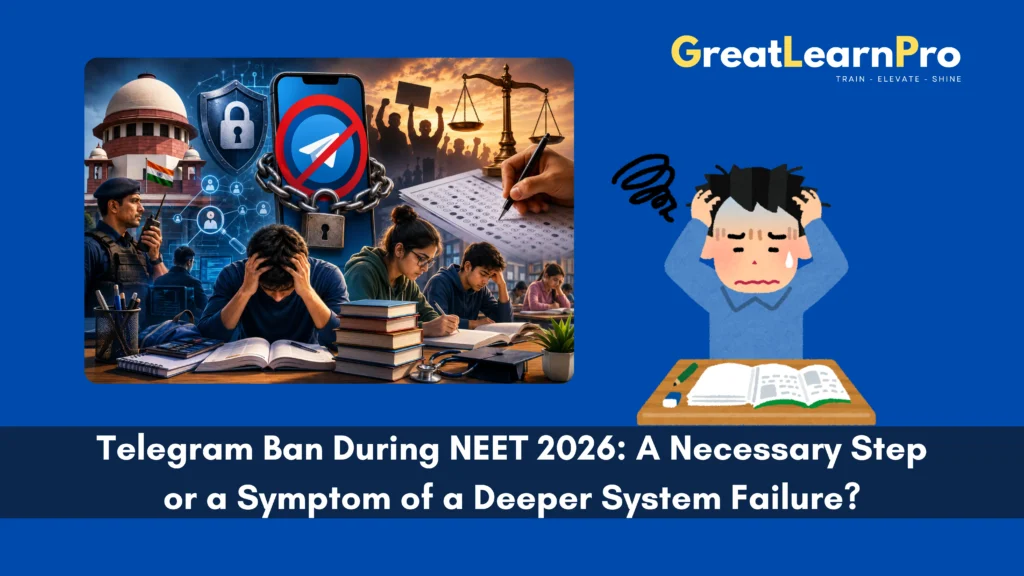
The decision of the National Testing Agency (NTA) and the Government of India to temporarily block Telegram ahead of the NEET (UG) 2026 re-examination has sparked intense debate across the country. While authorities describe the move as a necessary response to organized cheating networks, critics argue that banning an entire communication platform punishes millions of legitimate users for the actions of a few.
The controversy goes far beyond a messaging application. It raises important questions about examination security, digital rights, administrative accountability, and the growing crisis of trust in India’s competitive examination system.
Why Was Telegram Blocked?
According to the NTA, several Telegram channels and groups were allegedly advertising leaked NEET question papers and defrauding students by selling fake exam materials. Law enforcement agencies and the Indian Cyber Crime Coordination Centre (I4C) reportedly identified numerous groups involved in spreading misinformation and facilitating examination-related fraud.
The government responded by temporarily blocking Telegram and directing the platform to disable message-editing features until the end of June. Authorities argued that edited messages were being used to falsely claim prior access to examination papers by modifying old posts after the exam.
From a security perspective, the government’s objective was straightforward: prevent the spread of fake leaks, protect students from scams, and maintain the integrity of the NEET re-examination.
However, the larger question remains—should an entire platform be restricted because of the misuse by certain groups?
The Bigger Issue: India’s Recurring Examination Crisis
The Telegram controversy cannot be viewed in isolation. It is merely the latest chapter in a long series of examination-related controversies across India.
Over the last decade, several major recruitment and entrance examinations have faced allegations of paper leaks, impersonation, cheating networks, and administrative lapses. The NEET examination itself has repeatedly found itself at the center of controversy.
The 2024 NEET paper leak allegations triggered nationwide protests, legal challenges, and intense scrutiny of examination processes. Questions were raised about the security of question paper transportation, storage, and distribution mechanisms.
The recurrence of such incidents suggests that the problem is not merely technological. It reflects deeper structural weaknesses within the examination ecosystem.
When exam leaks become frequent, students begin losing faith in the fairness of the system. Honest candidates start believing that merit alone may not be enough to secure success.
Impact on Students: The Human Cost
The most significant victims of examination irregularities are students.
Every year, millions of aspirants dedicate months or even years preparing for highly competitive examinations such as NEET. Many students relocate to coaching hubs, invest substantial financial resources, and place enormous emotional expectations on a single examination.
When allegations of paper leaks emerge, the consequences are devastating:
- Students experience severe anxiety and uncertainty.
- Honest candidates fear that unfair advantages have been given to others.
- Re-examinations prolong stress and disrupt academic planning.
- Families bear additional financial and emotional burdens.
- Trust in public institutions declines.
For students already navigating intense competition, repeated examination controversies can create feelings of helplessness and frustration.
The issue is therefore not merely administrative; it is deeply personal for millions of young Indians.
Legal and Constitutional Concerns
The temporary blocking of Telegram also raises important legal questions.
India’s Constitution guarantees freedom of speech and expression under Article 19(1)(a), subject to reasonable restrictions. Critics argue that blocking an entire platform because of misuse by some users may be disproportionate.
This debate reflects a larger challenge in digital governance: balancing public interest with individual rights.
Supporters of the ban contend that extraordinary circumstances justified temporary restrictions. They argue that protecting the integrity of a national-level examination affecting millions of candidates constitutes a legitimate state objective.
On the other hand, civil liberties advocates question whether targeted enforcement against offending channels could have achieved the same objective without disrupting access for millions of legitimate users.
The incident highlights the need for clear, transparent, and proportionate standards when digital platforms are restricted.
Is Technology the Problem?
Blaming technology alone oversimplifies the issue.
Telegram, WhatsApp, Signal, and other communication platforms are tools. While they can be misused, they also serve legitimate purposes for education, business, journalism, and communication.
Telegram founder Pavel Durov argued that blocking the platform merely pushes offenders to alternative applications. There is merit to this argument.
History shows that whenever one communication channel is restricted, malicious actors often migrate to another platform. Therefore, platform bans may offer temporary disruption but rarely provide a permanent solution.
The root cause lies not in the application itself but in the criminal networks, administrative vulnerabilities, and weak enforcement mechanisms that allow such fraud to flourish.
What This Reveals About Systemic Failures
The repeated emergence of paper leak controversies points towards several systemic challenges:
- Weak Examination Security
Question papers remain vulnerable at multiple stages, including printing, transportation, storage, and distribution.
- Inadequate Real-Time Monitoring
Authorities often respond after suspicious content has already circulated widely online.
- Lack of Accountability
Investigations frequently identify intermediaries and local operators, but institutional accountability remains limited.
- Growing Commercialization of Examinations
A thriving underground market has emerged around leaked papers, fake answer keys, and fraudulent promises of guaranteed success.
Unless these structural issues are addressed, similar controversies will continue regardless of which platform is used.
The Road Ahead
The NEET 2026 Telegram controversy should serve as a wake-up call rather than merely another headline.
India requires a comprehensive examination security framework that combines technology, legal safeguards, and institutional accountability.
Key reforms could include:
- End-to-end encrypted monitoring mechanisms for examination logistics.
- AI-driven detection of suspicious examination-related online activity.
- Stronger coordination between examination authorities and digital platforms.
- Faster prosecution of organized cheating networks.
- Independent audits of examination security systems.
- Greater transparency in investigation outcomes.
- Student grievance redressal mechanisms that operate efficiently and credibly.
Most importantly, authorities must focus on preventing leaks rather than merely responding after they occur.
Conclusion
The temporary Telegram ban may have been intended to protect the integrity of the NEET 2026 re-examination, but it also exposed deeper concerns about examination governance in India.
The real issue is not whether Telegram was blocked. The real issue is why examination fraud continues to surface despite repeated controversies and reforms.
For millions of students, competitive examinations represent years of hard work, sacrifice, and hope. Protecting the credibility of these examinations is therefore not simply an administrative responsibility—it is a moral obligation.
The future of India’s examination system depends not on restricting communication platforms but on building institutions that students can trust. Until that happens, every new leak allegation will continue to raise the same troubling question: Is the system truly fair for those who play by the rules?
Sources Referred:
- National Testing Agency (NTA) – https://nta.ac.in
- Ministry of Electronics and Information Technology (MeitY) – https://nta.ac.in/Download/Notice/Notice_20260616120254.pdf
- Indian Cyber Crime Coordination Centre (I4C) – https://i4c.mha.gov.in/
- The Indian Express – https://indianexpress.com/about/neet-ug/
More Current Affairs: https://greatlearnpro.com/updates/