
The Mehta Chronicles: How Two Men Named Mehta Shook India’s Financial Core, 34 Years Apart
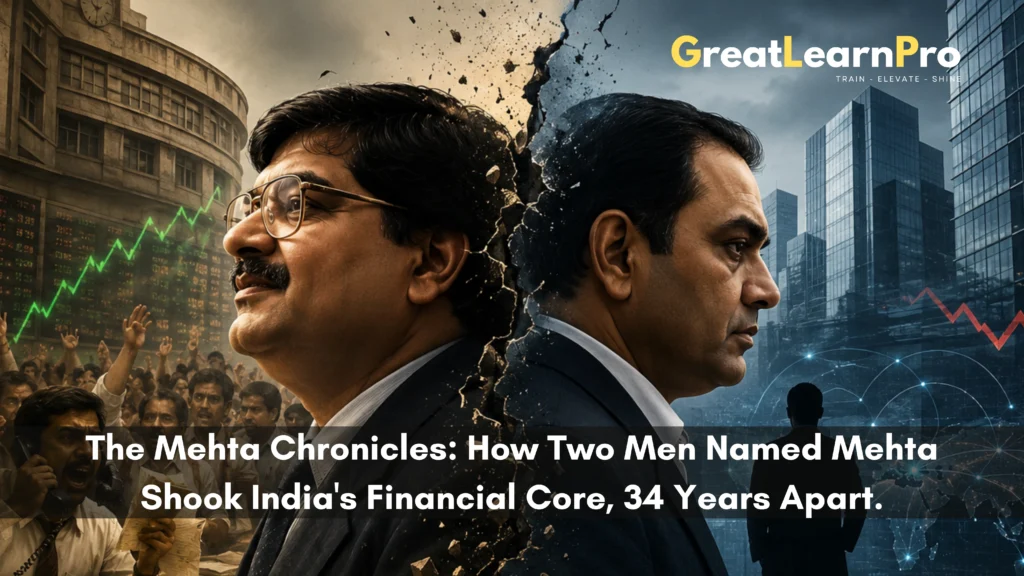
In Indian financial history, few names carry the kind of weight that “Mehta” does on Dalal Street. For decades, the name alone was enough to make seasoned traders pause – a single word that conjured the ghost of a charismatic stockbroker who once held the entire country’s markets in his palm. But history, it turns out, has an uncomfortable habit of echoing itself.
In June 2026, market regulator SEBI issued a 109-page interim order exposing Rajesh Mehta, promoter-chairman of gold giant Rajesh Exports, for an alleged revenue misstatement scandal totaling ₹15.15 lakh crore — roughly $1.8 trillion. Same surname. Different decade. Completely different playbook. Yet the damage, the disbelief, and the questions about how it was allowed to happen feel eerily familiar.
So how do these two seismic events compare — and what do they reveal about the evolving anatomy of financial deception in India?
The 1992 Blueprint: Harshad Mehta’s Banking Loop
To understand the present, we have to revisit the past. The early 1990s were a period of transformation for India — an economy just beginning to loosen its centrally controlled structures and open itself to market forces. The banking system of that era was manual, trust-heavy, and riddled with blind spots that an enterprising mind could exploit.
Harshad Mehta was that mind. An ambitious stockbroker who had clawed his way up from humble beginnings, he discovered a vulnerability buried inside a standard interbank lending mechanism called the Ready Forward (RF) deal. When banks needed short-term liquidity, they would sell government securities to other banks and buy them back later. Physical movement of bonds was impractical, so the system relied on Bank Receipts — paper documents that essentially said, “we have the securities.”
Harshad, working with corrupt bank officials, began fabricating these receipts. Fake Bank Receipts, backed by nothing, unlocked billions of rupees in unsecured cash from public sector banks. That money was then funneled into the Bombay Stock Exchange and pumped aggressively into a handful of selected stocks.
The results were staggering. Shares of Associated Cement Companies rocketed from around ₹200 to nearly ₹9,000 — not because the company had transformed overnight, but because an artificial flood of capital had distorted all sense of value. The BSE Sensex surged to historic highs, and Harshad Mehta became a celebrity, celebrated in newspapers and television as the “Big Bull” who had unlocked India’s market potential.
Then came April 23, 1992. Journalist Sucheta Dalal’s investigative report in The Times of India tore the curtain away. The scam valued at roughly ₹4,000 crore, or over ₹24,000 crore in today’s money — sent the markets into freefall. More than ₹1 lakh crore in market capitalization was wiped out. Middle-class families who had believed in the bull run lost their savings virtually overnight.
The 2026 Sequel: Rajesh Mehta’s Corporate Mirage
Fast-forward thirty-four years. India now has a digitalised market infrastructure, electronic Demat accounts, real-time surveillance systems, and a SEBI that carries genuine statutory authority — all reforms born directly from the 1992 crisis. The system should, theoretically, be harder to game.
And yet, on June 3, 2026, SEBI dropped a bombshell that suggested corporate deception had simply evolved to match the sophistication of the regulatory environment around it.
Rajesh Exports, a Bengaluru-based company that built its reputation on gold refining and its 2015 acquisition of Swiss refinery Valcambi SA, had long puzzled analysts. Its headline revenue numbers were extraordinary — consistently among the highest on Indian exchanges — but its profit margins were razor-thin, almost suspiciously so. The combination never quite added up. Now, SEBI’s preliminary findings suggest why.
According to the interim order, between FY21 and FY25, Rajesh Exports allegedly misrepresented revenues to the tune of ₹15.15 lakh crore. Approximately 97 to 99 percent of the company’s consolidated revenues were attributed to foreign subsidiaries — but these figures, SEBI alleges, failed to match any verified cross-border transaction trails. The picture that emerges is of circular gold transactions being recorded at their full gross value, inflating the apparent scale of the business by an almost unimaginable margin, while actual earnings remained a fraction of what was being reported.
The accounting manipulation, however, was only part of the story. A forensic audit further revealed that at least ₹926 crore was diverted from corporate accounts without board approval or audit committee oversight. Of this, approximately ₹339 crore allegedly bypassed mandatory related-party transaction disclosures entirely and flowed into accounts linked to Rajesh Mehta personally — funds that were reportedly used to bankroll private derivative trading positions.
The immediate market fallout was brutal. Retail investors watched in horror as the stock hit consecutive lower circuits. The Life Insurance Corporation of India, which held a 10.8% stake in the company, saw significant value erode. In total, over ₹12,725 crore in public shareholder wealth evaporated within days. Rajesh Mehta’s initial response — dismissing the findings as a “communication error” did little to stem the panic.
Two Frauds, Two Eras, One Pattern
The differences between these two scandals are as instructive as their similarities. Harshad Mehta operated from outside the corporate structure — a broker who exploited a primitive, paper-based system with physical forgery and back-channel bank relationships. His tool was raw liquidity: actual cash, pumped into the trading ring to artificially inflate prices. His fraud was loud, visible, and eventually exposed by the sheer impossibility of sustaining the stock valuations he had manufactured.
Rajesh Mehta’s alleged fraud operated from the inside — a promoter-chairman at the top of a listed company, using corporate structure itself as a weapon. No fake Bank Receipts here; instead, a web of foreign subsidiaries, cross-border transactions, and accounting entries that exploited the complexity of international supply chains. The scale is incomprehensible by comparison: ₹15.15 lakh crore in misrepresented revenues against ₹4,000 crore in diverted bank funds. The former represents an accounting mirage; the latter, blunt theft.
Yet at their core, both scandals share a common failure: the collapse of institutional trust. In 1992, banks trusted each other’s paper. In 2026, institutional investors, auditors, and even regulators trusted a company’s consolidated financials — without, apparently, verifying whether the numbers behind them were real.
What This Means for Every Indian Investor
For retail investors, the lessons are painful but necessary. The 2026 Rajesh Exports case is a stark demonstration that a globally recognised brand, enormous headline revenues, and major institutional shareholders — including a sovereign insurer like LIC — do not guarantee that a company’s financial disclosures are genuine. Rajesh Exports had all the appearances of a serious, well-governed global enterprise. It owned a Swiss refinery. It appeared in major indices. It published audited annual reports.
None of that stopped the alleged fraud from running for five consecutive financial years.
Rigorous due diligence means going beyond the headline numbers. Auditor notes, related-party transaction disclosures, the gap between revenue and actual cash generation, the geographic concentration of revenues — these are not dry footnotes. They are the places where financial reality and financial fiction diverge.
Both Mehta scandals ultimately rewrote the regulatory playbook of their times. The 1992 crisis gave India a modernised SEBI, digital exchanges, and electronic Demat accounts. The 2026 crisis is already pushing regulators toward mandatory forensic verification of foreign subsidiary revenues and real-time cross-border transaction auditing — a reckoning with the limits of trusting paperwork over ground-truth financial flows.
History does not repeat itself exactly. But it rhymes — and in India’s financial markets, it has rhymed with remarkable precision across thirty-four years, one surname, and two very different blueprints for deception.
Sources Referred:
- SEBI Official Interim Order Page – https://www.sebi.gov.in/enforcement/orders/jun-2026/interim-order-in-the-matter-of-rajesh-exports-limited_101820.html
- National Stock Exchange (NSE) Rajesh Exports Press Release Archive – https://nsearchives.nseindia.com/corporate/RAJESHEXPO_04062026172846_RelPressReleaseJune042026.pdf
- The Hindu BusinessLine Report –https://www.thehindubusinessline.com/markets/rajesh-exports-shares-fall-10-in-two-sessions-amid-sebi-probe-rajesh-mehta-rejects-1515-lakh-cr-scam-charge/article71063926.ece
More Current Affairs: https://greatlearnpro.com/updates/